


Normally in this newsletter, we focus on cutting-edge research—studies published in the last few weeks or months.
But every so often, it’s worth stepping back and revisiting the foundational trials that shaped modern medicine.
Today, we’re doing just that—looking back at one of the most pivotal studies in cardiovascular history: the 4S trial, short for the Scandinavian Simvastatin Survival Study. (Say that five times fast)

What was the Famous 4s Trial?
According to cardiologists, the 4S trial—first published in 1994 in the Lancet—is widely regarded as the study that launched the statin era.
4S was a randomized, double-blind, placebo-controlled study that enrolled 4,444 participants (Wow, that’s ironic! Four fours in 4S. Sorry… Shut up ADHD) with established coronary heart disease.
Patients were assigned to receive either simvastatin (20–40 mg daily) or a placebo and followed for 5.4 years.
The headline findings were that simvastatin significantly reduced overall mortality, cardiovascular mortality, and major cardiovascular events.
But there’s another part of the story—one that didn’t get nearly as much attention.
So today, we’re digging into a follow-up study published in Circulation in 2001 that reanalyzed 4S participants, not by LDL cholesterol (LDL-C) alone, but by their HDL-C and triglyceride (TG) levels as well.
What it reveals has important implications for how we think about risk—and treatment—today.
Grouping Patients by HDL-C and Triglycerides
This follow-up study examined how statin treatment affected outcomes based on patients’ baseline lipid profiles—specifically in two subgroups:
Group 1: The “Lipid Triad”
Those with TG in the highest quartile (quarter) and HDL-C in the lowest quartile, were termed the the Lipid Triad group because the participants had a triad of lipid risk markers. This high-TG and low-HDL-C pattern is characteristic of insulin resistance and metabolic syndrome.
Group 2: Isolated High LDL Cholesterol
Then, there were those with TG in the lowest and HDL-C in the highest quartile. This was termed isolated high LDL-C group in the study.
So how did these groups differ in terms of outcomes?
Look at this graph.
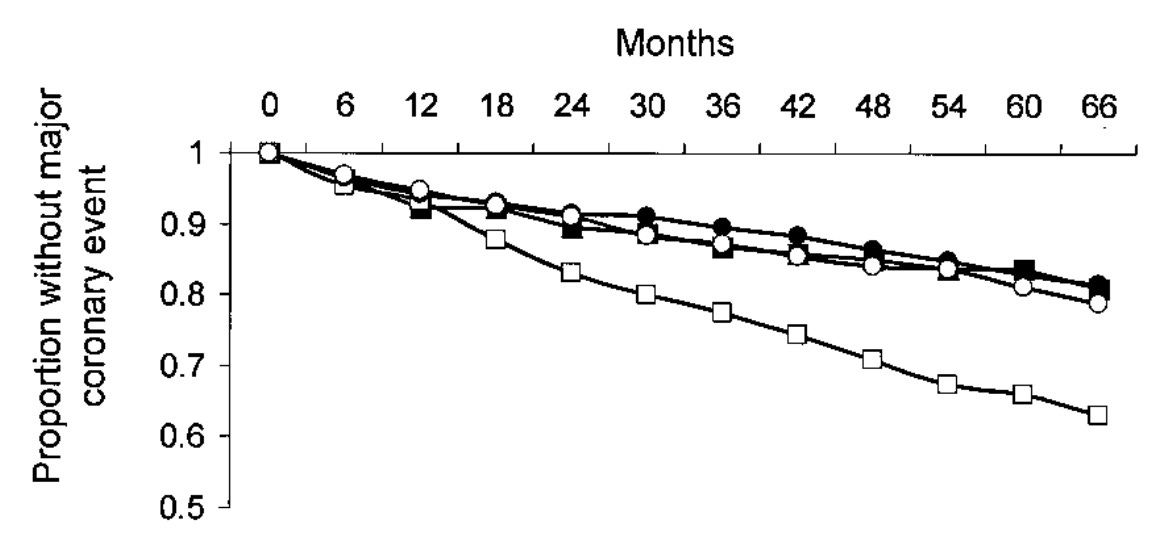
The x-axis is time, and y-axis represents the proportion of patients without coronary events—which means as the line drops, more patients in that group are experiencing events.
A flatter line = better outcomes. A steeper drop = worse outcomes.
And here, one group stands out—like a sunburned elephant in the Arctic.

That group?
Those open squares?
That is the untreated lipid triad group—those with high TG and low HDL-C. They experienced the steepest drop, meaning they had the highest rate of coronary events.
Simply put: The group with elevated LDL-C and ApoB plus markers of metabolic dysfunction, was at greatest risk—and saw the most benefit from statin therapy.
But the real surprise is in the clustering of the remaining groups.
When Statins Have Diminished Cardiovascular Benefits
The other three groups—including treated and untreated patients with “isolated” high LDL-C (I’ll unpack the quotes in a moment), showed similar and significantly lower event rates.
So, the punchline: In patients with isolated high LDL-C but higher HDL-C and lower TG, the benefit of statins on cardiovascular risk was drastically reduced.
Conversely, statins help more when metabolic health is impaired.
This isn’t entirely surprising, given that statins have “pleiotropic effects”—meaning their benefits extend beyond simply lowering LDL-C and ApoB.
For example, they can:
Improve endothelial function, enhancing blood flow when vascular dilation is impaired.
Reduce inflammation, particularly when baseline inflammation is already elevated.
In individuals with poor metabolic health, these additional effects may contribute meaningfully to improved outcomes.
Moreover, LDL-C and ApoB lowering can take on a different significance depending on the metabolic context.
By way of analogy, lowering LDL and ApoB in someone with poor metabolic health is like taking sparks out of a dry forest—you’re reducing the chance of a wildfire. But lowering LDL in someone who’s metabolically healthy is more like removing sparks from a rainforest—the conditions for combustion aren’t there to begin with, so the impact is far less dramatic.
In the rest of this letter—available exclusively to StayCurious Premium members—we dive deeper into the nuances:
Plot twist! It wasn’t isolated high LDL cholesterol after all!
Beyond the Heart: A broader lens on statins—how they impact metabolic and mitochondrial health, insulin sensitivity, and more.
Actionable markers: Which lab values and ratios to actually track if your goal is metabolic optimization.
Supplements & Strategy: The latest practical steps I’m exploring, drawing from data new and uncovered…
Take the leap. Join Premium and find out why so many members call StayCurious the “best investment I’ve ever made in their health.”
