


I recently did a radical dietary experiment — and something totally unexpected happened.
I became cold-resistant.
Taking off my shirt on an icy Boston winter day didn’t feel like a blast of frigid air. It felt almost like a cool, soothing summer breeze.
Now, I’m going to tell you what I did that had this effect. But first, I want to share the idea behind it… Why I think this makes sense.
The food we eat isn’t just fuel.
It can be the raw material our bodies use to make hormones.
So, when you change your diet, change your hormones— including the ones that tell our bodies to take stored energy and convert it into heat energy, revving up our metabolism.
In my case, it’s like my mitochondria flipped into “thermogenic beast mode.”
It felt weird. It was unexpected. But it also makes sense. Let’s dig in…
An Unexpected Finding: Why am I Cold Resistant?
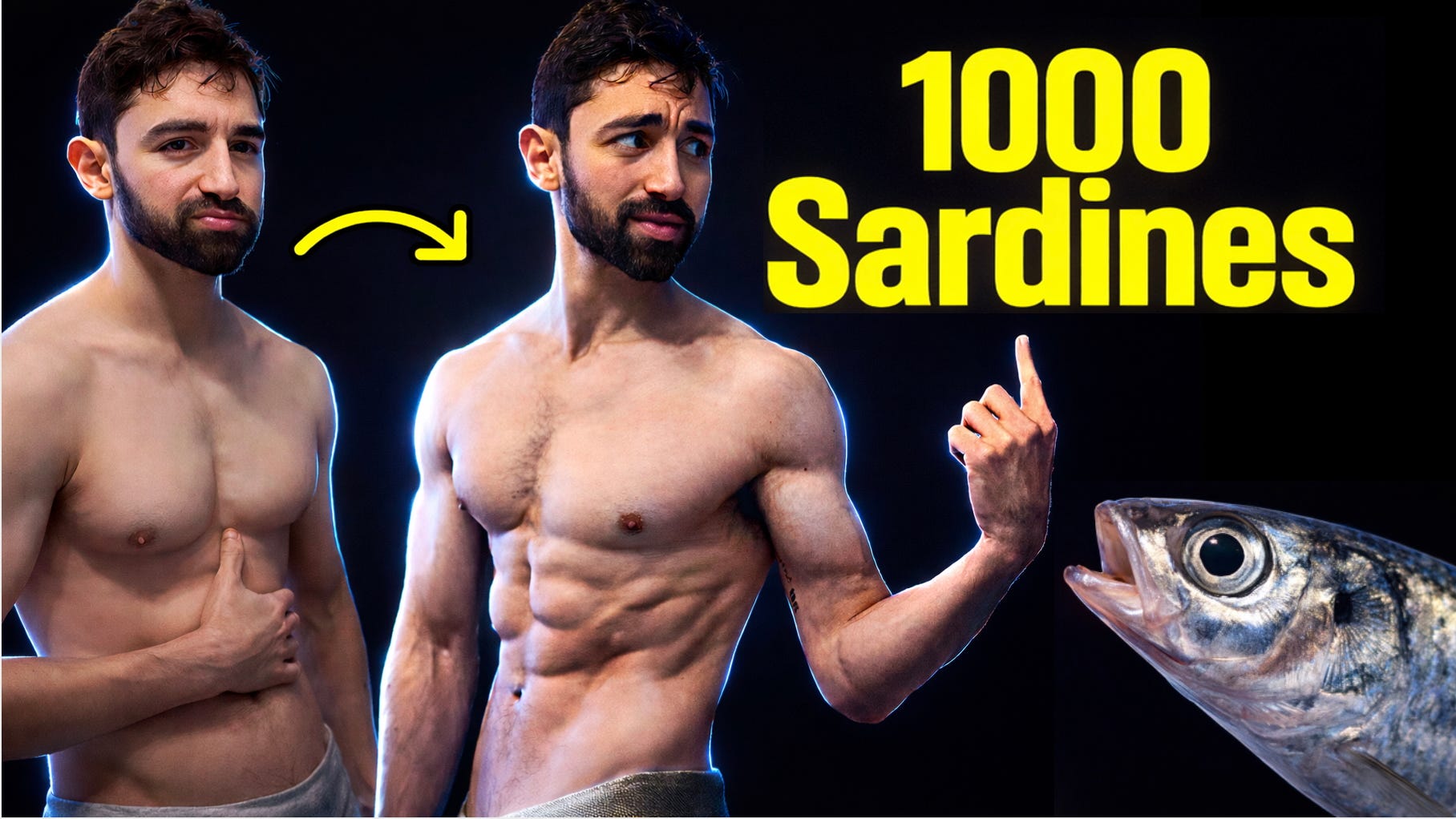
I recently did a self-experiment that can be summarized in just two words: Sardine Diet. If you’re curious about the rationale, I walk through the details HERE.
But here’s something that surprised me: after a couple weeks on this extremely high omega-3 diet, I became conspicuously cold-resistant.

This was weird.
And I wanted to understand what might be happening. So, I dug into the literature — and eventually found a fascinating 2019 paper in Cell Metabolism.
At a high level, here’s what the study showed.
Wait!!! I’m going to give you the punchline, but only if you promise to stick around for the critical details to come... Promise? … Okay, I trust you.
Metabolically active brown fat can convert omega-3 fatty acids into a hormone called 12-HEPE.
12-HEPE stimulates thermogenesis in brown fat, and ramps up glucose uptake into muscle as well.
This ultimately promotes heat production, cold adaptation, and energy expenditure.
Now, let’s get into the details…
What is Brown Fat? And 12-HEPE?
If you haven’t heard of brown fat before, it’s a specialized organ that produces heat.
Despite its name, “fat,” it’s derived from the same precursor cells as muscle cells; thus, in a way, it’s more related to muscle than fat in its family tree.
And like muscle, it burns tons of energy — but specifically to generate heat.
Adult humans don’t have a ton of brown fat, but we have some as well as the ability to convert normal storage fat (white fat) into a brown-fat like state called beige fat.
Anyway, omega-3s can be converted into the 12-HEPE hormone, which in turn stimulates thermogenesis (heat production) and ramps up glucose uptake into brown fat and muscle — not into regular white (storage) fat.
But let me walk you through some of the data so you don’t have to just take my word for it, and you can see how I connect the dots between PubMed and Personal experience.
The researchers wanted to move past the oversimplified narrative that brown fat’s benefits are just to produce heat and “burn calories.”
Instead, they viewed brown fat as an endocrine organ — more like your thyroid or adrenal glands—capable of producing hormones that act throughout the body. In fact, brown fat hormones even have a name, “batokines.”
Anyway, what are these hormones? And how do they work?
Part 1: The Mouse Experiments
To begin answering that, the researchers started with a mouse model.
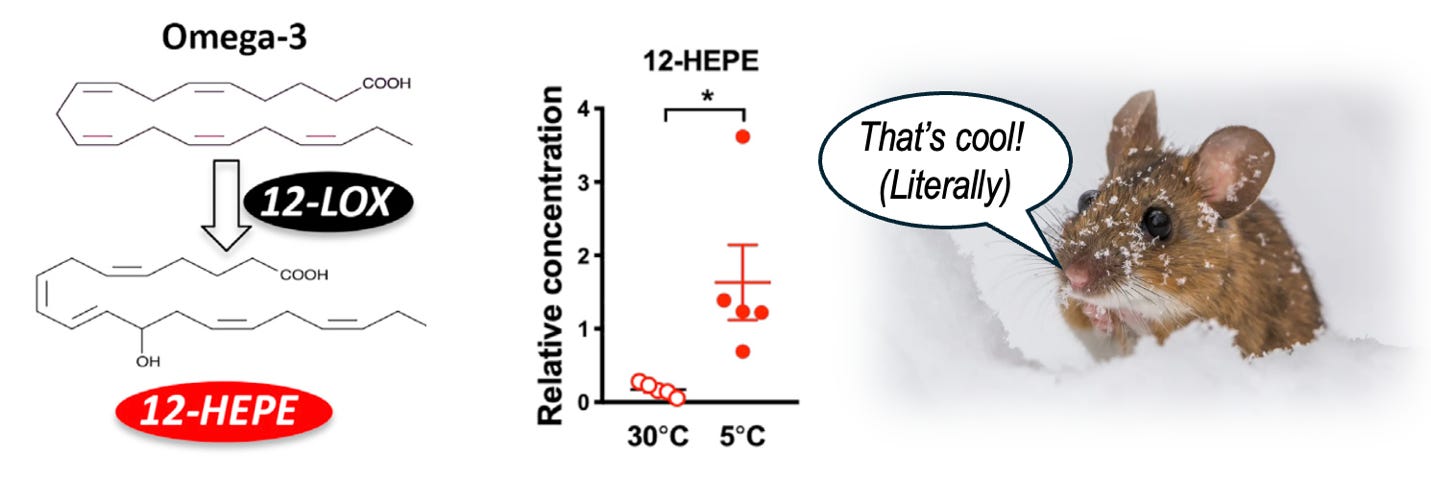
Mice were exposed to cold temperatures (5°C) or thermoneutrality (room temperature). After cold exposure, researchers measured changes in circulating blood metabolites.
Several metabolites increased with cold exposure, but one that stood out was 12-HEPE, which is synthesized by the enzyme 12-lipoxygenase (12-LOX) from omega-3 fats.
Cold Triggers a Cascade
Further experiments showed that cold exposure activated a signaling cascade:
Cold exposure → activates β-adrenergic signaling.
This triggers activation of 12-LOX (short-term); and it triggers increased 12-LOX gene expression (longer term), amplifying its effect.
12-LOX turns omega-3 into 12-HEPE.
12-HEPE is secreted and can act on brown fat to increase glucose uptake and thermogenesis (heat production) and increase glucose uptake into muscle.
This, ultimately, promotes cold adaptation and glucose tolerance.
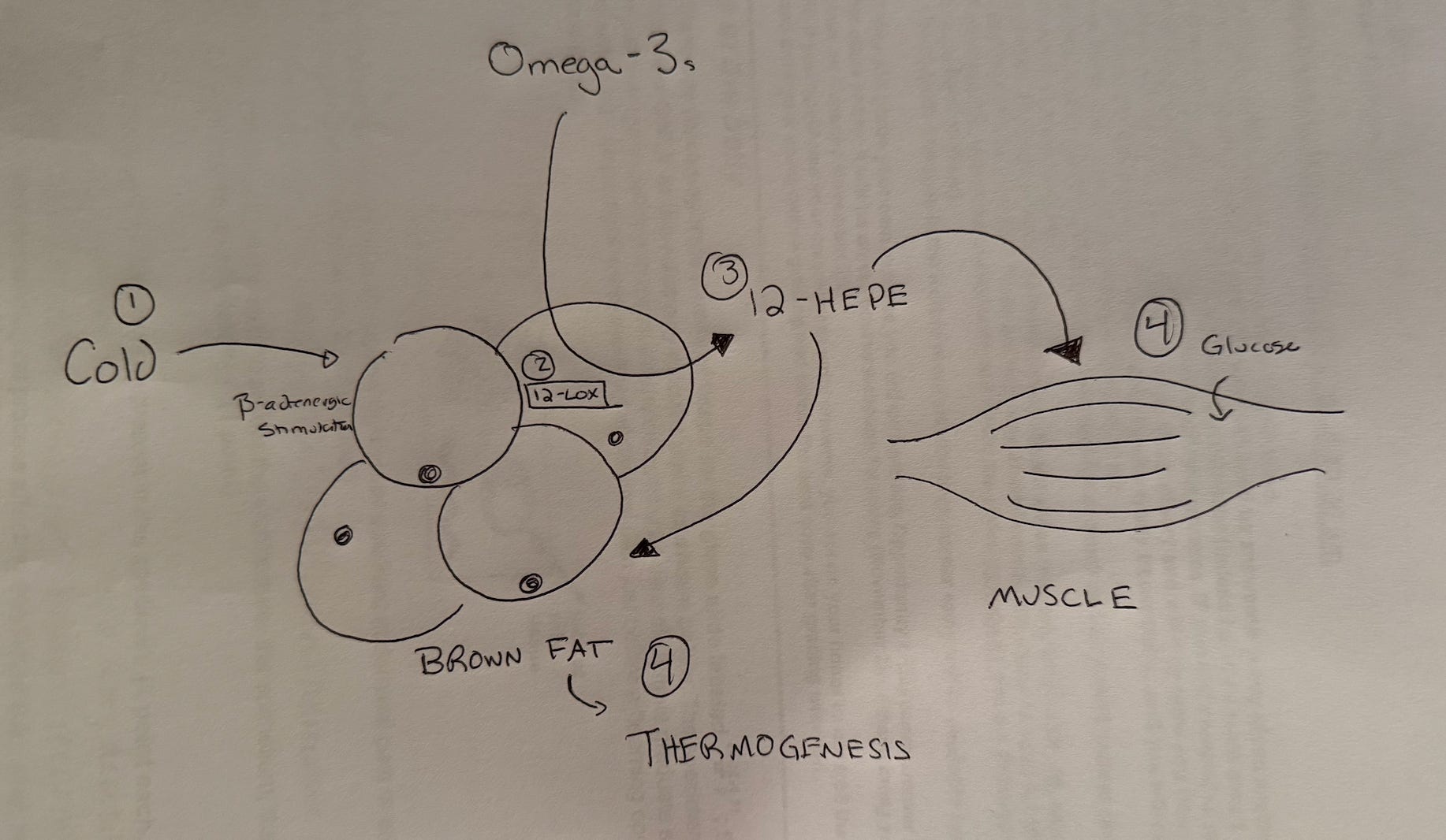
And — to double click on a key point — the ability of 12-HEPE to cause glucose uptake is preferential for brown fat and muscle over normal white fat (storage fat).
In the rest of this letter, we’ll explore:
Human evidence: Randomized controlled trials showing how mimicking cold exposure can boost 12-HEPE adaptive metabolic activity.
Obesity as a “12-HEPE–deficient” state: and what that means for metabolic health.
Power of Diet: How it can steer 12-LOX activity toward either adaptive (12-HEPE) or harmful pathways.
The Bigger picture: What all of this ultimately means for your metabolism and your health.
