


When I personally tried statin therapy as part of an experiment, I quickly developed muscle pain — a common side effect, particularly with high-dose statins. The medical term for this is myalgias.
But what concerned me wasn’t just the sensation of pain — it was what that pain might represent.
To me, it felt like a canary in the coal mine — a warning signal. If something detrimental was happening inside my muscles to my mitochondria, what might that mean for my long-term health?
Could it influence my risk of developing chronic diseases down the line? That’s still an open question in medicine, but one worth asking.
In this letter I’m going to cover:
The Striking Human Data: A look at a study showing how statins can harm mitochondria in humans.
Targeted Support: Specific supplements and lifestyle strategies you can use to protect and enhance your mitochondrial health.
My Response: Thoughts on key feedback on another popular study on statins.
System-Level Failure: Why research like this, including human randomized controlled trials, often fails to reach your doctor's office.

Important Caveat: The Tool Should Match the Task
But I’ll hit this feedback right off the bat: I know the immediate pushback will be, “But statins reduce cardiovascular events,” particularly in patients with established disease, when used as part of secondary prevention. I’m not denying that. I also acknowledge that statins can offer benefits beyond lowering LDL or ApoB — including potential anti-inflammatory effects.
But here’s the point: the right tools need to be used for the right job. You don’t use a chainsaw to drive in a nail. You use a hammer. And you don’t fell a tree with a hammer, either. It’s all about context — the right tool for the right task.
In the same way, the right medication should be used for the right patient.
Just because statins may reduce mortality in a patient with obesity and preexisting cardiovascular disease does not mean statins will benefit a lean, otherwise healthy person who has high cholesterol. In fact, in that context, the potential for long-term harm may outweigh any benefit. That should not be a controversial statement.
Statins Harm Muscle Function (Human Study)
Now to the study at hand was published last year in the Journal of Clinical Investigations. The researchers enrolled an equal number of men and women with overweight or obesity and treated them with 80 mg of atorvastatin daily for 56 days.
One of the key metrics they assessed was muscle oxygen consumption — specifically, how quickly muscles recovered after exercise. This recovery rate, known as mVO₂, is a direct indicator of the muscle’s aerobic capacity.
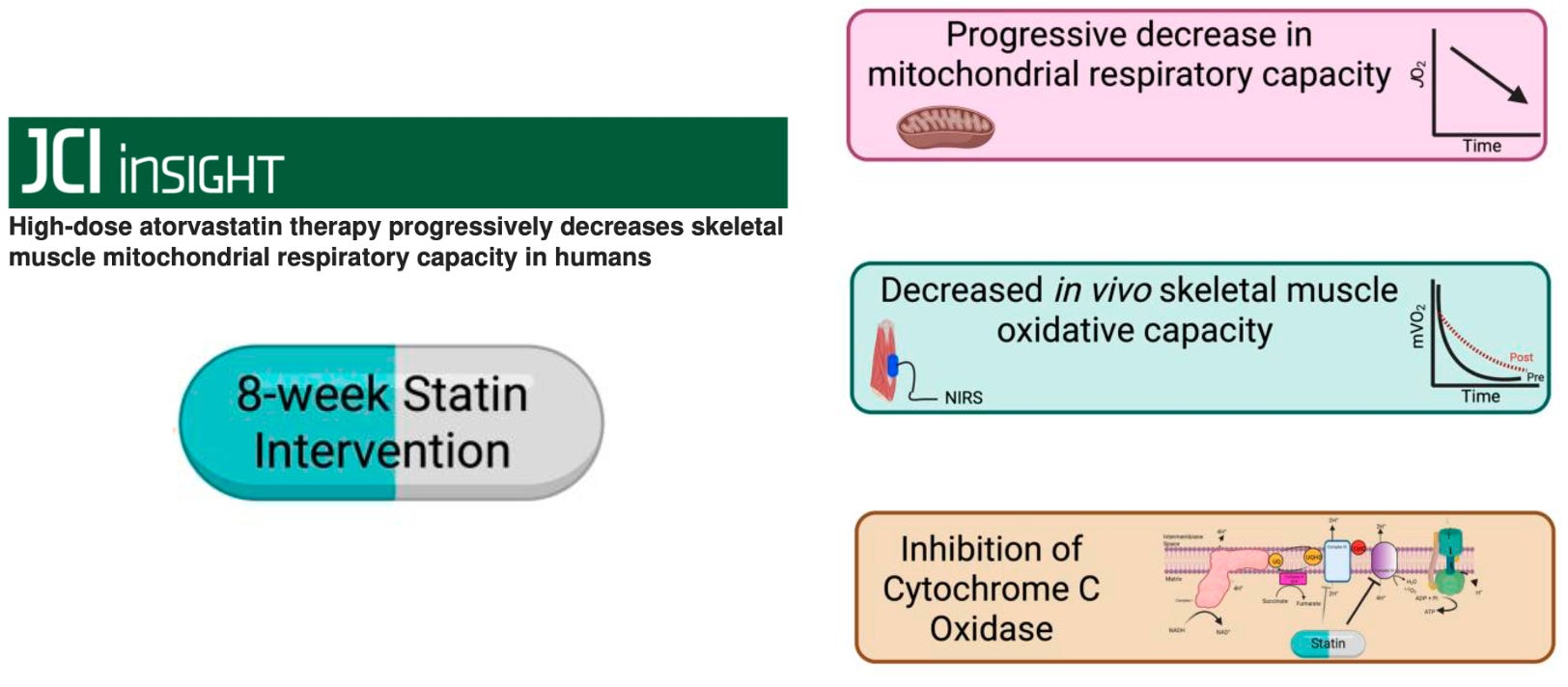
What they found was striking: there was a 23% reduction in the rate constant of muscle recovery. To quote the authors, this “indicates a decrease in muscle oxidative capacity.”
In simpler terms, statins impaired a functional metric of muscles metabolism.
What might be causing this?
Statins Inhibit Mitochondrial Function at Very Low Concentrations
Since mitochondria are the metabolic engines of the cell, it's reasonable to suspect that the root cause of the muscle problem might derive from mitochondrial damage.
To explore this possibility, the researchers performed a series of mitochondrial assays on muscle biopsies taken after an overnight fast.
Across these analyses, a consistent pattern emerged: statin therapy progressively reduced mitochondrial function.
One of the most affected components was complex IV of the mitochondrial electron transport chain. Even at very low concentrations — as little as 10 nm — atorvastatin inhibited complex IV activity by >50%.
Quoting directly from the study: “The magnitude at which mitochondrial respiratory capacity in skeletal muscles decreased in response to 8 weeks of high-intensity atorvastatin treatment was striking.”

So, I want to raise an open-ended question — one only you can answer: How does any given medication, statin or otherwise, weigh out in your own personalized risk-benefit analysis, taking into account all the outcomes that matter to you? Not just heart health, but also brain function, muscle integrity, and overall well-being.
That’s not a question anyone else can answer for you. But it's a question worth asking. With that in mind, I want to offer a few practical thoughts and mitochondrial health tips.
In the rest of this letter, we discuss:
Statin Alternatives: Non-statin lipid modifying medications that are less likely to harm mitochondria.
Specific Supplements: What to consider taking to support mitochondrial function, including the most bioavailable form of CoenzymeQ
Sleep and Mitochondrial Dynamics
Exercise and “Progressive Overload”
My Response feedback on another Statin Human Controlled Trial where Statins Slashed GLP-1 levels by 50%
Healthcare Incentives: Why this is all a bigger problem than most realize
