For years, my own body tried to eat itself from the inside.
That’s not hyperbole.
That’s roughly what ulcerative colitis is: your immune system turning on your gut. And the standard medicines didn’t work for me. What finally did was an extreme anti-inflammatory diet.
That said, even now, in hard-won remission, my gut keeps a tell: it flares when I’m stressed. International travel. Relationship issues. The usual things all of us deal with as a function of being human.
For a long time I chalked that up to bad luck. Then I read the science, and realized it isn’t luck at all. It might be a nerve.
Here’s the claim, and I know how it sounds:
You can use your mind—and some fancy new gadgets—to change the inflammation in your body and, ultimately, bend the course of real diseases like ulcerative colitis and rheumatoid arthritis.
Out loud, it’s pure wellness-influencer woo.
Except the biology says otherwise. Your brain is wired directly into your immune system; it reads your inflammation in real time and talks back to it. Which makes this idea the rarest kind: simultaneously far-fetched and rigorously, mechanistically true.
But the stakes here are greater than even I realized.
For example, in the introduction to the first paper we’re going to discuss today, I learned that inflammatory bowel diseases shorten patients’ lifespans by 10 years on average due largely to increased risks of complications like sepsis and cancer associated with chronic inflammation.
So, the stakes here aren’t just an upset tummy.
For some people, they are literally life and death.
But the lessons we’re going to learn apply to every single one of us.
We’re going to talk more broadly about using the brain to control inflammation later on, but I want to spend most of our time together today focusing on one system in particular: the gut and gut inflammation.
What follows is some rather stunning science about the connection between your nervous system (particularly your vagus nerve) and inflammation.
And I’m going to pull out practical insights you can use today.
I’ll share them with you not only out of the generosity of my heart, but also as a selfish act: these are interventions I want to start using myself.
The Study That Hit Closest to Home
I’ll start with the paper that drew a mechanistic line from a stressful state of mind all the way down to the molecular machinery of colitis, in both mice and human tissue.
And this mechanistic line comes with an unexpected twist.
The setup was simple. Researchers stressed mice that had severe inflammatory bowel disease. The stressed animals didn’t merely get sicker. Their colitis turned lethal, the whole stressed group dying within days of a challenge the unstressed animals survived.
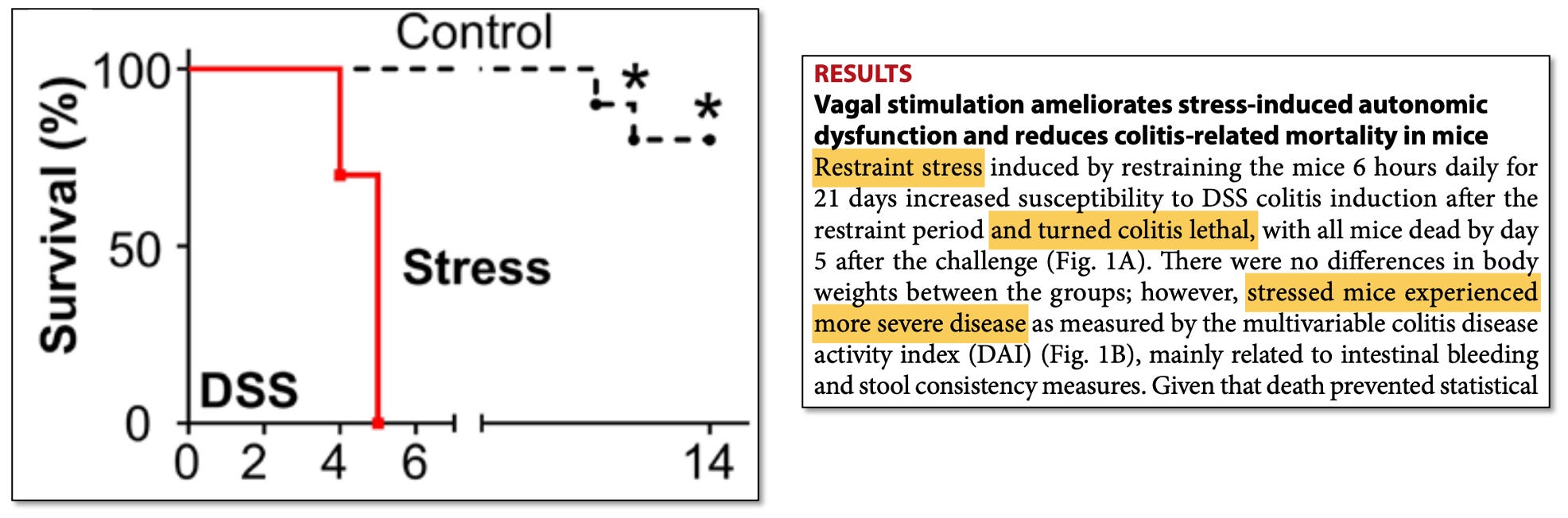
That’s not some esoteric biomarker: that’s life and death.
The stress, in addition to the inflammatory disease, did “something” to make the disease worse… so much worse that it killed.
What changed?
Here is the first clue: the vagal signature, read through heart-rate variability, had shifted threefold in the direction of collapsing parasympathetic tone. Simply stated, the “rest and digest” arm of the nervous system was tuned way down.
And, importantly, this wasn’t a matter of stress hormones, like cortisol, flooding the animals’ bloodstreams: it was a nervous system phenomenon… or at least appeared to be.
So the researchers tried switching it back on.
A short burst of electrical stimulation to the vagus nerve (VS, blue) in the neck, and the outcomes reversed.
Stimulated mice were rescued from lethal colitis. Their disease scores fell, their intestinal bleeding stopped, their gut barrier held, and the inflammatory signals in the colon dropped (IL-6, TNFα), while anti-inflammatory signals (IL-10) rose.
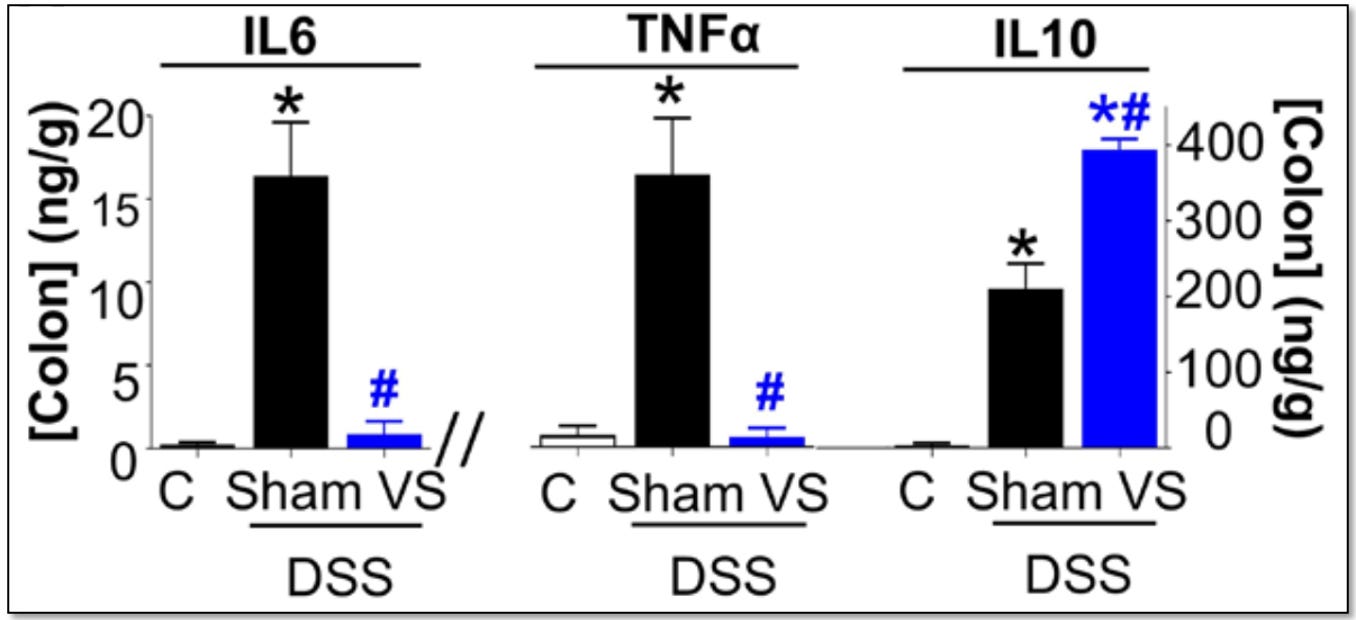
We will get to evidence for a clinical effect in humans momentarily, but even in mice consider what this means: tuning the nervous system can change inflammation in the body to such a great extent that it can be the difference maker between life and death.
How Does It Really Work?
Now the mechanism…because this is where it stops being simply fascinating and turns absolutely weird!
Because here’s a problem: the vagus nerve has very little direct input into the colon. So, stimulating the vagus nerve can calm inflammation, but how?
How can it change what it barely touches?
The answer is that the vagus doesn’t calm the colon by reaching down and touching it. It works through a middleman: the spleen.
Picture the spleen as a staging ground for your immune system—a barracks where inflammatory cells are marshaled before they deploy into the body. The vagus nerve has a line straight to that barracks. And in this study, when the researchers surgically removed the spleen, vagal stimulation lost its power to protect the gut. Cut out the middleman, and the message never arrives.
That’s the first twist I promised you. The next arrives when we ask the question:
What’s happening at the biochemical level to tune inflammation?
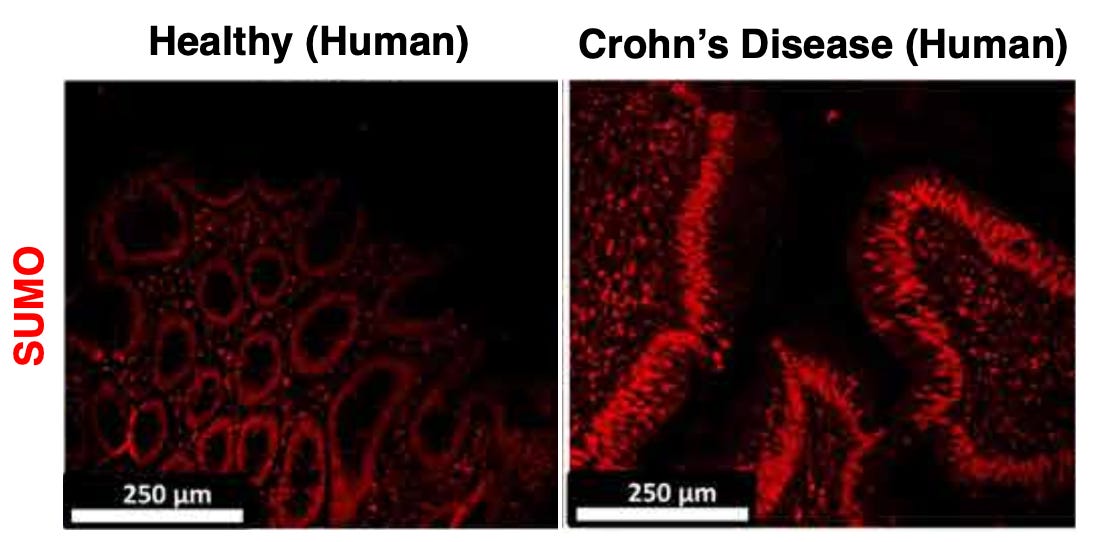
What was actually doing the work was something you probably haven’t heard of called “SUMOylation.”
It’s a molecular tagging system—cells attach small proteins called SUMO onto other proteins to change how they behave, a stress dial that gets cranked up during inflammation. This tag was elevated in the colon tissue of human Crohn’s patients (below, red), and in the mouse colitis.
Vagal stimulation turned it down, dropping one SUMO form by roughly 70%.
The nerve was, through a twisted line through the spleen, modifying the gut’s own molecular stress machinery to turn down the inflammatory dial.
And then the finding that quietly reframes the whole “natural versus pharmaceutical” debate. The team took a drug—a SUMOylation inhibitor already in cancer trials—and used it in place of the nerve. It reproduced the vagus nerve’s protective effect across three separate models of colitis, and it reduced the gut leakiness and bacterial translocation that drive colitis toward sepsis death!
Brief Summary So Far, and Relevance
But let’s boil this all down as simply as we can before moving to our next paper:
Stress lowers vagal tone
Low vagal tone worsened gut inflammation
Restoring vagal activity calmed inflammation.
Read those three lines again, because the implications run deep.
The first line means your mental state is not walled off from your gut. Stress isn’t merely “in your head”—it has a physical wire running straight into the machinery of intestinal inflammation.
For me, this resonates.
My worst ulcerative colitis flares clustered around international travel, something that is, for me, disproportionately stressful. (I know, ironic given my now chosen career. I’m getting better at it and try to see me weaknesses as challenges to combat, rather than threats from which to hide.)
This paper offers a mechanism. Travel spikes my stress, stress drops my vagal tone, and low vagal tone takes the inflammation brakes off my gut. The pattern I lived finally has a wiring diagram.
The second and third lines are the hopeful half.
If dropping vagal tone can make disease worse, then raising it should be a lever in the other direction.
But I owe you honesty about where this evidence stands. As striking as it is, most of these data lives in mice, with human tissue as corroboration. Mice are not people. A rescued mouse is a promise, not a prescription.
So here’s the next question that matters most:
Can stimulating the vagus nerve control inflammatory disease in humans?
And remarkably, we now have a randomized, double-blind trial that gives us an answer.
In the rest of this letter for StayCurious Metabolism premium members, we’ll dive into:
The human trial that makes all of this real
How the vagus nerve acts as a biological rheostat on inflammation
Practical levers you can start using today
And the device I’m using to stimulate my Vagus nerve
If you love diving into hardcore biology and exploring the frontier of human metabolism, health, and longevity, you’re going to feel right at home in the StayCurious Metabolism community. Please consider becoming a part of what makes it so special.