


A brand-new paper has just been published that claims to challenge a “century-old dogma” that Alzheimer’s disease is irreversible.
When I first read the brief, a yellow flag immediately went up.
That’s a big claim—and big claims demand strong data. And, while no single study is ever definitive, I must admit my initial skepticism was misplaced.
This is a genuinely impressive piece of work!
The authors combine multiple complementary animal models with corresponding human data in a way that is both rigorous and unusually coherent.
Taken together, the results make a compelling case for a new therapeutic paradigm—not just slowing the progression of Alzheimer’s disease but preventing or potentially even reversing it.
Roadmap:
Meet NAD+: The brain’s metabolic linchpin—and why it matters for Alzheimer’s.
Two Brains, Same Disease: How some people stay sharp despite Alzheimer’s pathology.
Lab Breakthroughs: How boosting NAD+ prevents or reversed Alzheimer’s disease in animals
Human Data: Evidence that the same mechanisms may apply to us.
Action Steps: A dive into proven ways to support NAD+—naturally and safely.
How to increase NAD+ production
How to decrease NAD+ consumption
The NAD+ checklist
*My Promise: You’ll walk away not only with deeper understanding and practical tools, but with the same sense of optimism swelling in my chest as I write these words.
*Disclosoure: It’s also worth noting that I’m writing this letter as much for myself and my family as for you. My parents and I carry a genetic variant (ApoE4) that increases our risk for Alzheimer’s disease. That makes understanding the biology of this disease more than an academic exercise.
NAD+: An Essential Player in Brain Health and Aging
To understand why this paper is so interesting, you need to understand one central molecule.
It’s called NAD+—short for nicotinamide adenine dinucleotide.
NAD+ is a vital compound found in every living cell and plays a foundational role in energy metabolism. You’ve probably heard of ATP, the energy currency of the cell. Well, NAD+ is just as essential.
At its core, it functions as an electron carrier, shuttling high-energy electrons through processes that make life possible: glycolysis, the TCA (Krebs) cycle, oxidative phosphorylation and ultimately mitochondrial energy production.
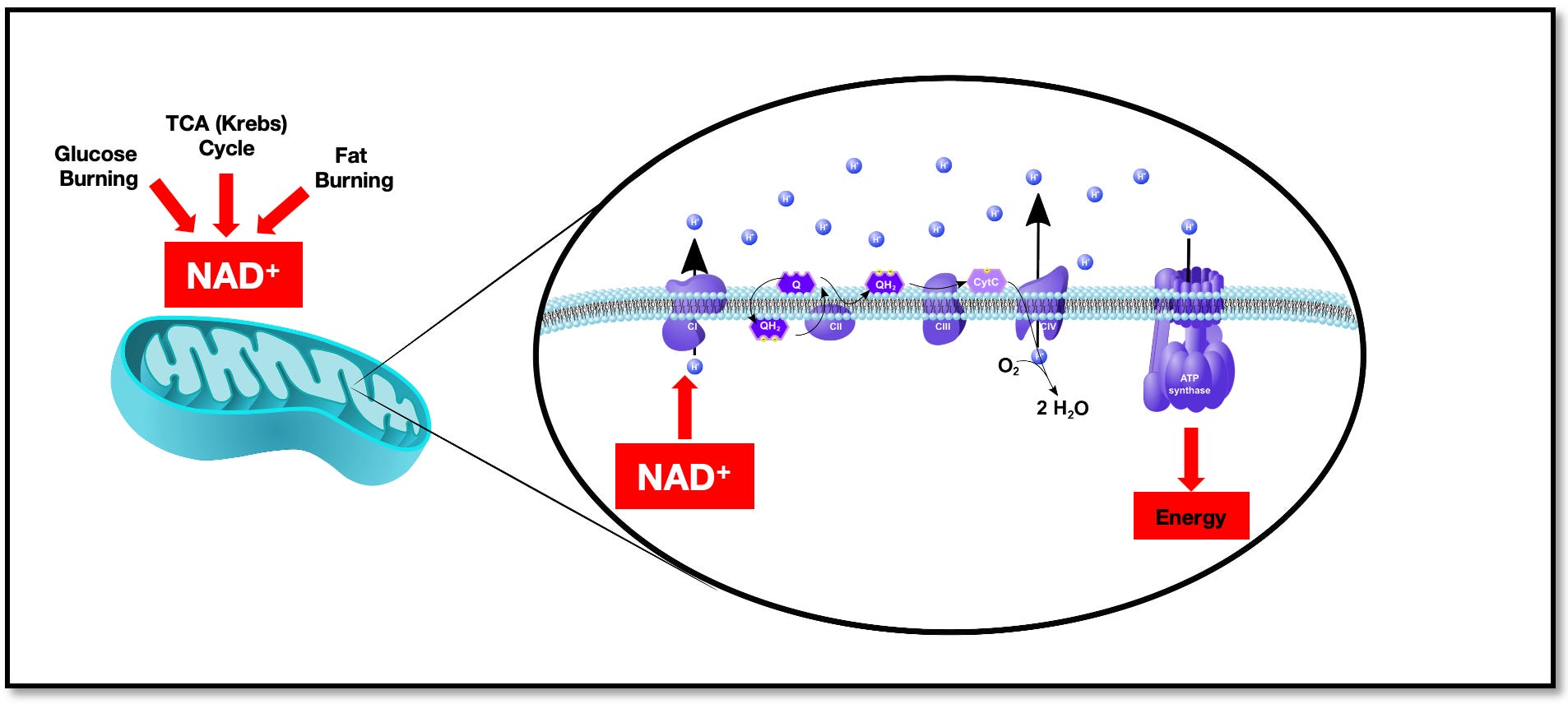
Without NAD+ cells simply don’t function.
Mitochondria fail. Energy production collapses. Without NAD+, you’d die faster than if you were hit by the Avada Kedavra curse.
Here’s the crucial point: NAD+ levels tend to decline with age and with metabolic disease.
And when that decline happens faster or more severely than expected for normal aging—something that may itself represent a pathological state—it contributes to mitochondrial dysfunction, disrupted cellular signaling, and chronic metabolic diseases, including Alzheimer’s disease.
The Alzheimer’s Paradox: NAD+ vs Amyloid
This brings us to a fascinating and long-standing paradox in human neuroscience.
The classic pathological hallmark of Alzheimer’s disease—amyloid plaques—does not correlate particularly well with symptoms.
Some people have substantial amyloid pathology in their brains yet never develop dementia. In fact, 20 – 50% of those with high amyloid plaque burden are cognitively normal.
These individuals are referred to as ‘non-demented with Alzheimer’s neuropathology’ (NDAN).
And here’s where this new study gets especially interesting.
One of the defining features that distinguishes the non-demented brain from a brain with Alzheimer’s disease is NAD+ levels.
Higher NAD+ levels appear to act as a kind of resilience factor—buffering neuronal function despite the presence of pathological hallmarks of Alzheimer’s.
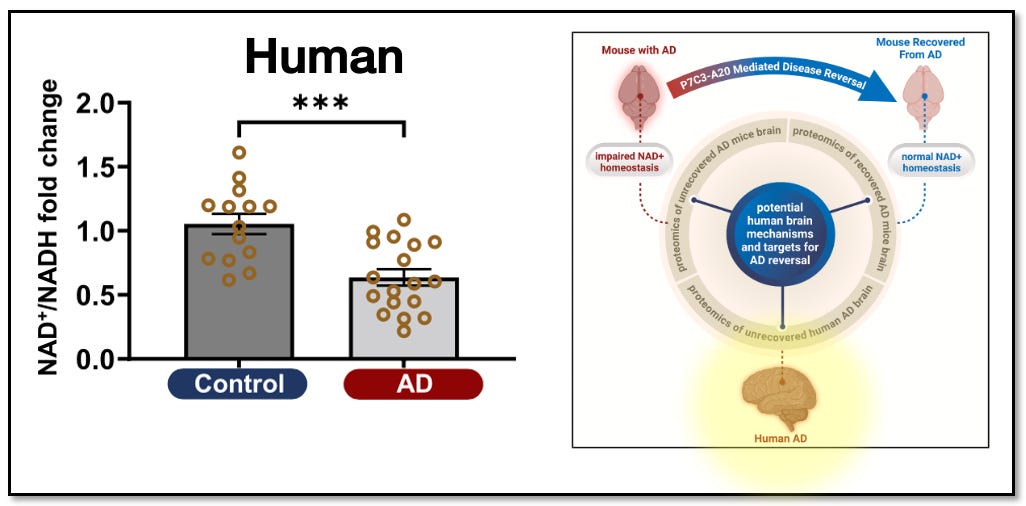
If that’s true, it raises a provocative possibility: if we can restore or preserve NAD+ levels in the brain, we may be able to defend against Alzheimer’s disease—not by targeting plaques directly, but by supporting the metabolic and energetic resilience of neurons themselves.
Maybe, we could even reverse Alzheimer’s disease?
Now let’s unpack how the authors tested it—and what they found.
I’m proud of all my letters, but this one feels different. It’s something special. If you’re not already a Premium subscriber, now’s the perfect time to find out what everyone’s been talking about. I promise—it’s nuance worth your nickel! And if you change your mind, you can unsubscribe anytime, no hard feelings.
