


Obesity is a major risk factor for heart disease. But why? And how?
Is it just a correlate, or is there something about fat tissue that damages blood vessels and the heart? Breaking new science gives us insight into the biological truth – and lays the groundwork for solutions.
We’re going to review the science, tell you what bloodwork you can check to gain insight into your blood vessel function, and reveal nuances about the crosstalk between fat and blood vessels that would have your cardiologist’s head spinning.

Obesity is Associated with Worse Blood Vessel Function
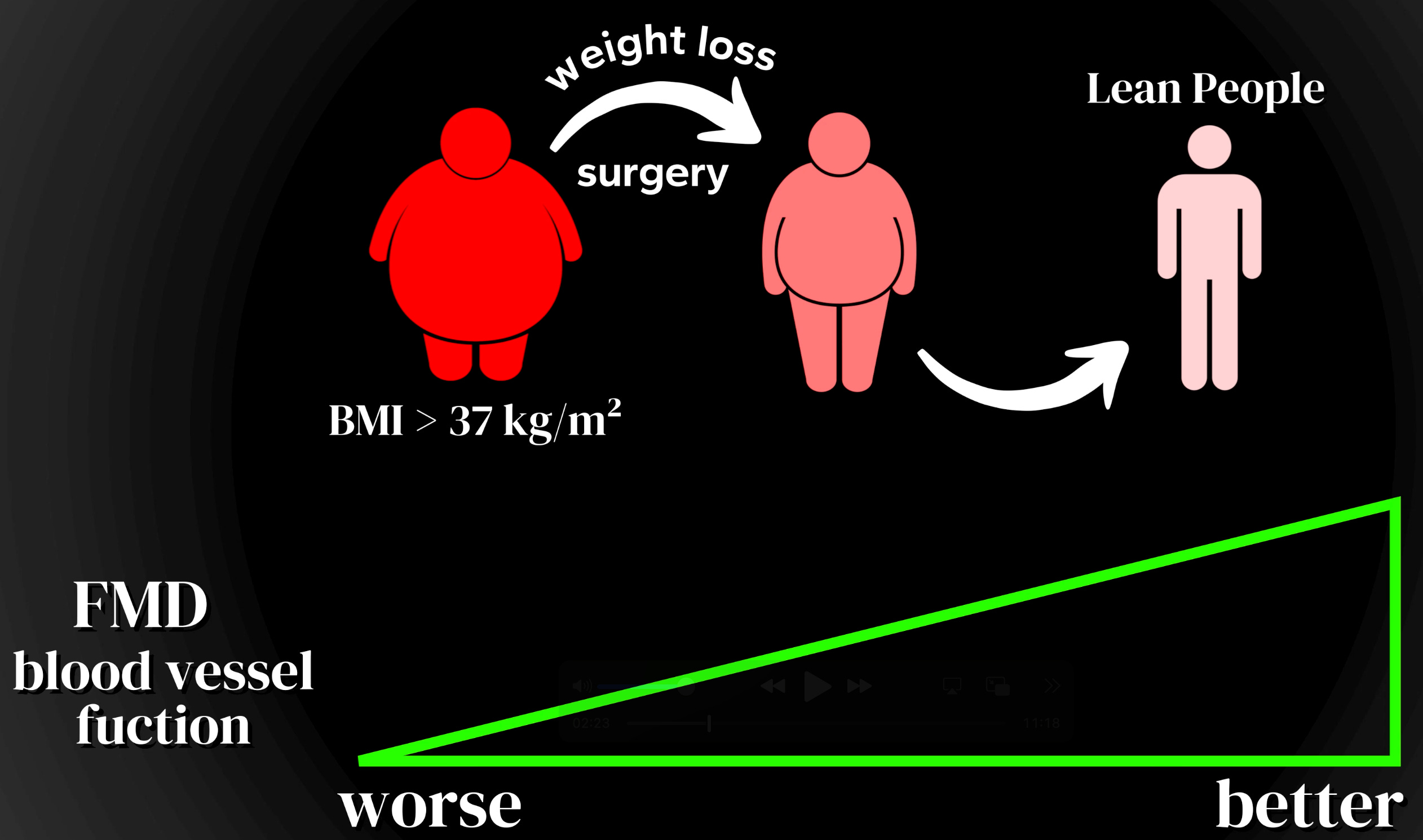
Let’s begin with the first human study. Researchers took patients with obesity and BMIs of >37 kg/m², before and after they underwent weight-loss surgery, and compared them to lean people.
They were comparing them for blood vessel function and an important marker called myeloperoxidase (MPO). Let’s unpack this a bit more…
There are different ways you can measure how well your blood vessels function, which is critical to overall heart and metabolic health. No surprise, blood flow is important—it’s the river and stream that feeds your organs with nutrients.
One way to measure blood vessel function is called flow-mediated dilation (FMD), which is a measure of the body’s ability to widen blood vessels in response to increased blood flow.
The researchers found that people with obesity had worse flow-mediated dilation than lean people.
Furthermore, flow-mediated dilation improved with weight loss.
And, there was an inverse correlation between BMI and flow-mediated dilation.
All this suggests that worse obesity = worse blood vessel function, and vice versa.
But now, what about MPO?
Myeloperoxidase (MPO) - A Metabolic Pincer Maneuver!
MPO is a blood marker of oxidative stress and an enzyme produced by inflammatory cells. It generates potentially harmful reactive oxygen species chemicals, like hypochlorous acid (HOCl), that can damage blood vessels.
MPO also leads to the oxidation of LDL particles, contributing to the progression of cardiovascular disease.
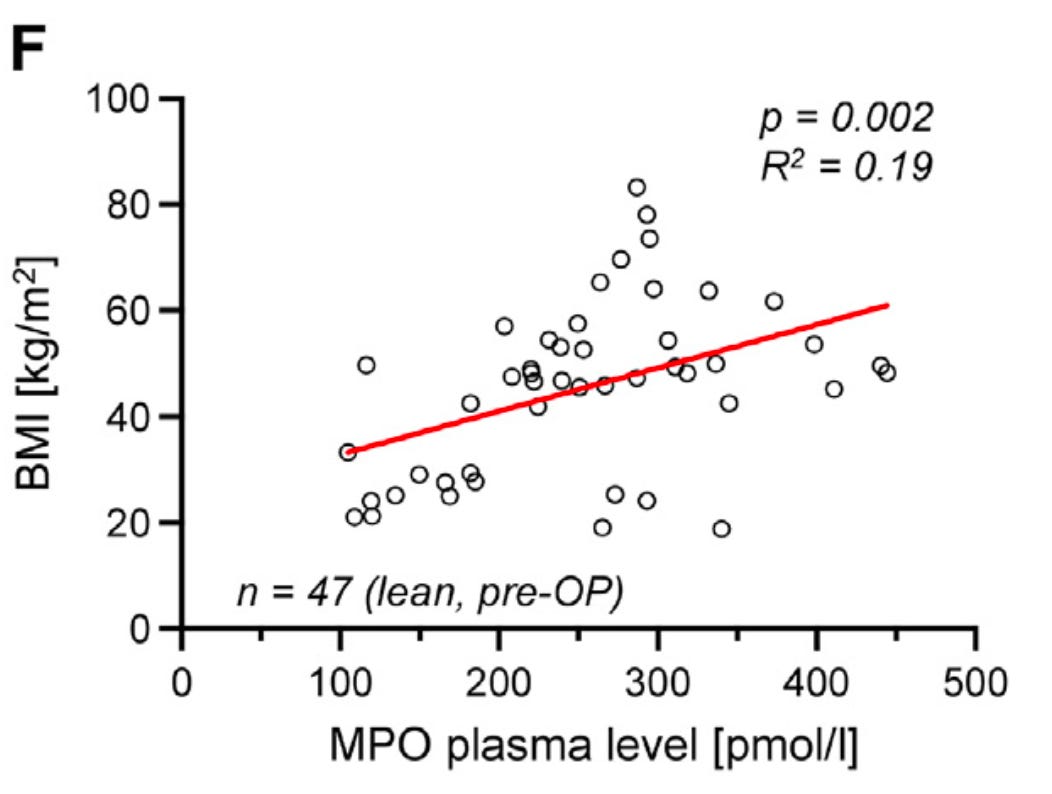
Interestingly, the researchers found that MPO correlated with BMI, suggesting worse obesity = more MPO, which could explain the relationship between excess body fat, worse blood vessel function, and poorer cardiovascular health.
But it gets more complicated—and more interesting.
MPO floats around inside blood vessels and can hurt them from the inside-out, directly damaging blood vessel lining and oxidizing LDL particles. But there is also fat tissue around blood vessels called perivascular adipose tissue (PVAT). “Peri” means around, and adipose tissue is fat—so this translates to “fat around blood vessels.”
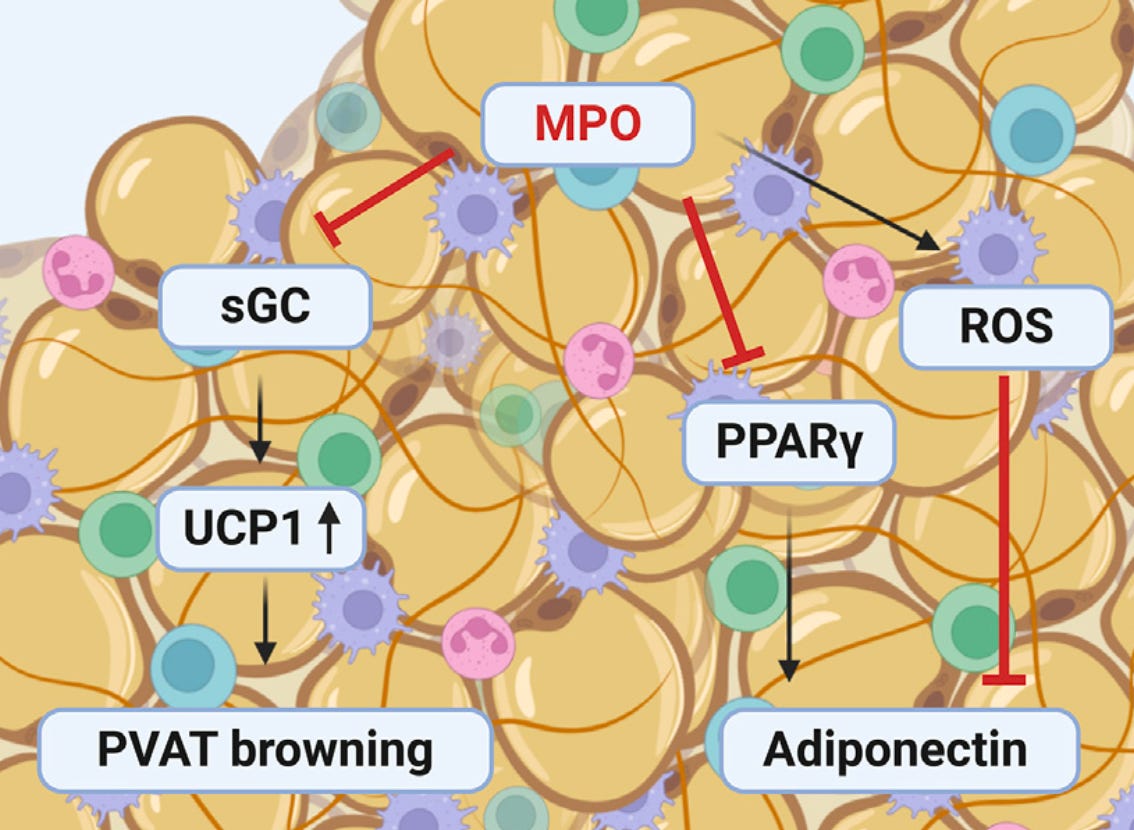
MPO in the PVAT can also harm vessels from the outside-in. It’s like a metabolic pincer maneuver!
And what the researchers show throughout the rest of the paper is that the MPO in the perivascular adipose tissue is a signal that inhibits important, beneficial metabolic processes—like (i) the “browning” of fat tissue to burn more energy, and (ii) the generation of the hormone adiponectin.
Let’s dive deeper into these nuances.
MPO inhibits Perivascular Fat Browning
There are different types of fat with different metabolic properties. Brown fat generates heat and burns more energy, providing some protection against obesity. White fat, which is more typical in adult humans, can take on brown fat properties in a process called “browning” or “beiging.” MPO inhibits this process.
That means: more MPO = less browning/beiging = less energy burning.
You can see how this sets up a vicious cycle whereby excess fat and less healthy fat tissue leds to the buildup of even more unhealthy fat.
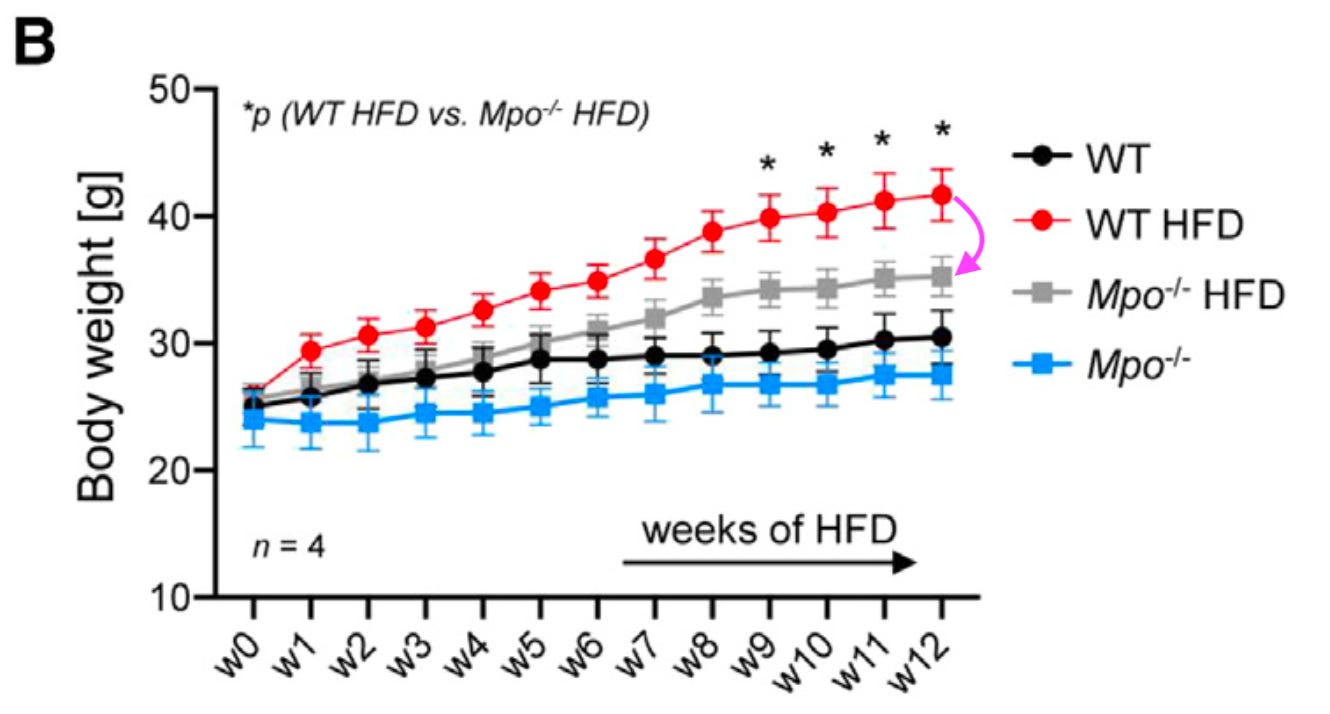
They even showed, in genetically modified mice, that eliminating MPO protected against diet-induced weight gain (pink arrow) and improved blood vessel function.
Adiponectin: Sending Your Blood Vessels to Yoga Class
I also mentioned the hormone adiponectin. Adiponectin improves blood vessel function by making vessels less stiff.
Adiponectin is basically yoga for your arteries.
So, more MPO means less adiponectin—and stiffer, worse-functioning blood vessels.
What’s more, adiponectin itself inhibits MPO production by immune cells. So reduced adiponectin leads to the generation of more MPO, which further reduces adiponectin—setting up another vicious cycle!
That’s concerning, to say the least.
How to Improve Your MPO Levels and Blood Vessel Function
But I don’t mean for this video to be doom and gloom. I mean for it to be empowering! You can measure & modify your MPO levels. MPO is, in fact, a blood marker you can get ordered at many labs. And now you’re beginning to understand what it means.
It’s true, you’re measuring the MPO in your blood, rather than in the fat around your blood vessels—but these two levels tend to correlate.
In the rest of this letter we discuss:
4 ways to lower MPO
MPO ad Mental Health
MPO and Seed Oils
