*News note: The big news of the last few days was the negative result of the Lp(a) HORIZON trial, a large Phase 3 trial in which an Lp(a)-lowering drug failed to reduce cardiovascular events. The cardiology world is in a little bit of a free fall right now. Whether or not you’re aware of this trial, I’ll provide my commentary in a postscript at the end. All the teachings herein still apply. You just get a little extra nuance.
When I was first diagnosed with elevated Lp(a), I was scared.
I knew what the numbers meant.
Statistically, my lifetime risk of a heart attack was dramatically higher—perhaps by as much as 230%. And because heart disease runs in my family, this wasn’t just an abstract statistic.
I inherited high Lp(a) from my father, who almost died of a heart attack at just 44 years old.
I had every reason to be frightened. I’m not anymore.
What changed wasn’t my genetics. My Lp(a) is still high. What changed was my understanding.

The Lp(a) Myth
Over the past few years, Lp(a) has gone from obscurity to becoming the newest cardiovascular supervillain.
Darth Vader. Thanos. Voldemort. Pick your franchise.
And if you’re interested in heart health, you’ve almost certainly heard that elevated Lp(a) substantially increases cardiovascular risk.
What you may also have heard is that “it’s almost entirely genetic.” And “there are no medications available shown to lower Lp(a) and reduce cardiovascular risk.”
Those statements have truth to them.
There’s also, “so there’s nothing you can do about it.”
That one? That one is dead wrong.
While your Lp(a) level is largely determined by your genes, the amount Lp(a) increases your cardiovascular risk is not.
Point blank.
And, if you understand how Lp(a) causes disease and focus on the right interventions, you can meaningfully reduce the risk associated with it. That’s what this newsletter is about.
Think of it as your definitive guide to Lp(a):
What it is
How it works inside your body
And what you can do about it
By the end, you’ll have a practical, evidence-based playbook for reducing your risk, whether your Lp(a) is elevated or not.
What is Lp(a)?
Let’s start by defining Lp(a). To understand it, you first need to understand its better-known cousin: the LDL particle.
LDL and Lp(a) both belong to the family of ApoB-containing lipoproteins because they’re built around the structural protein apolipoprotein B (ApoB). In fact, for the most part, they look almost identical.
Think of them as tiny tennis balls floating through your bloodstream. The difference?
Lp(a) has a tail called apo(a).
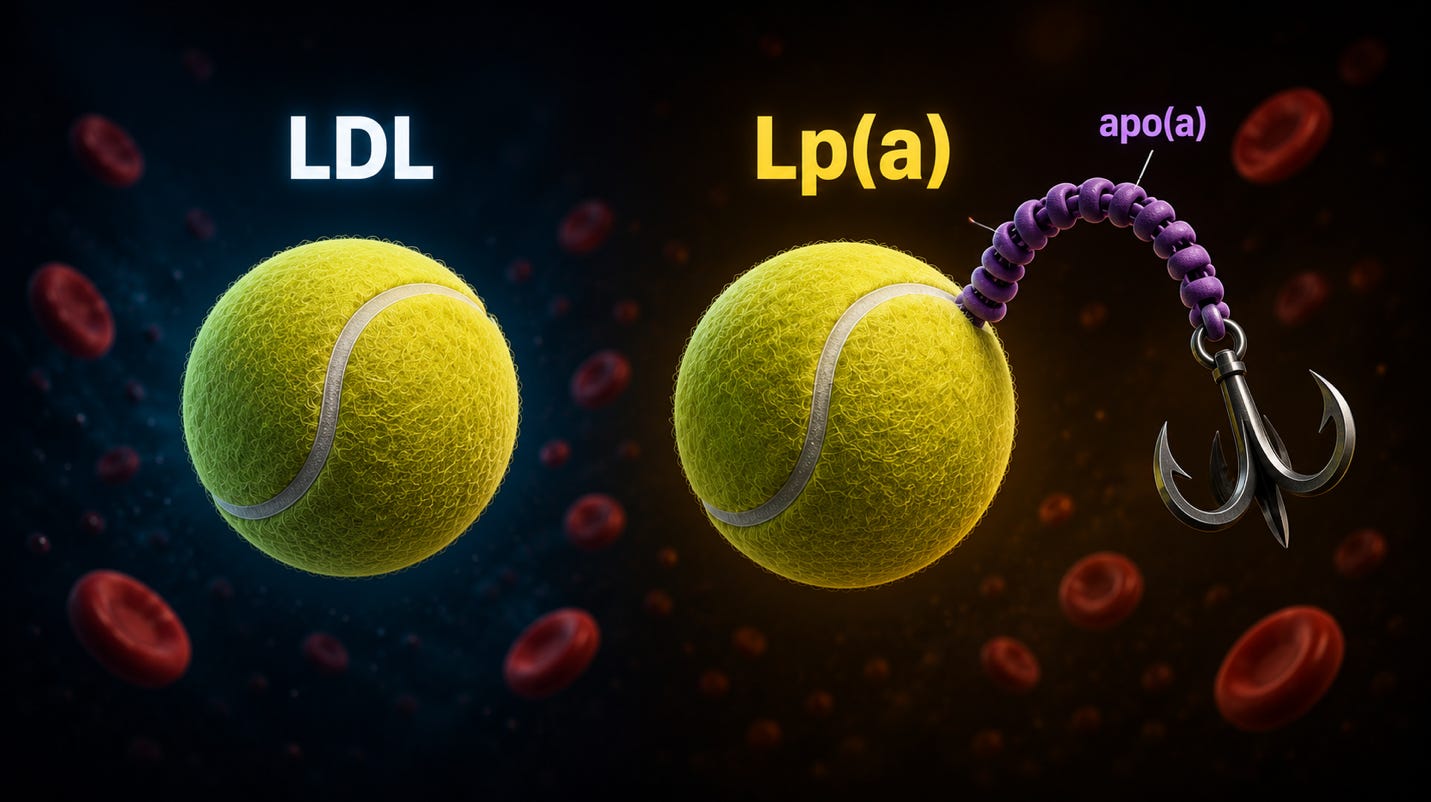
If an LDL particle is a tennis ball, Lp(a) is a tennis ball with a grappling hook attached to the back. As it travels through your arteries, that grappling hook allows it to latch onto things that a regular LDL particle would simply drift past.
It’s this extra “stickiness” that helps explain why, on a per-particle basis, Lp(a) is estimated to be roughly 6-times more atherogenic than LDL alone.
The biology is more complicated than that—and we’ll get there—but I think this mental picture is a useful place to start.
There’s one more critical thing to understand about Lp(a):
Your level is overwhelmingly determined by genetics.
Me, personally? I can bound my LDL and ApoB around like a yo-yo with lifestyle alone. But I can barely budge my Lp(a).
Specifically, the LPA gene, which encodes that grappling-hook tail, contains a variable number of repeating structures called “Kringle repeats.” If Kringle sounds like a pastry, that’s because it is one. The protein loops resemble the shape of the Danish pastry, which is how they got their name.

Here’s the key concept:
Longer tail = lower Lp(a).
I know that sounds backwards. Here’s how it’s thought to work:
Particles with longer apo(a) tails are more likely to be broken down by the liver before they’re released into the bloodstream.
Shorter tails escape that quality-control process more easily, so more particles end up circulating in your blood.
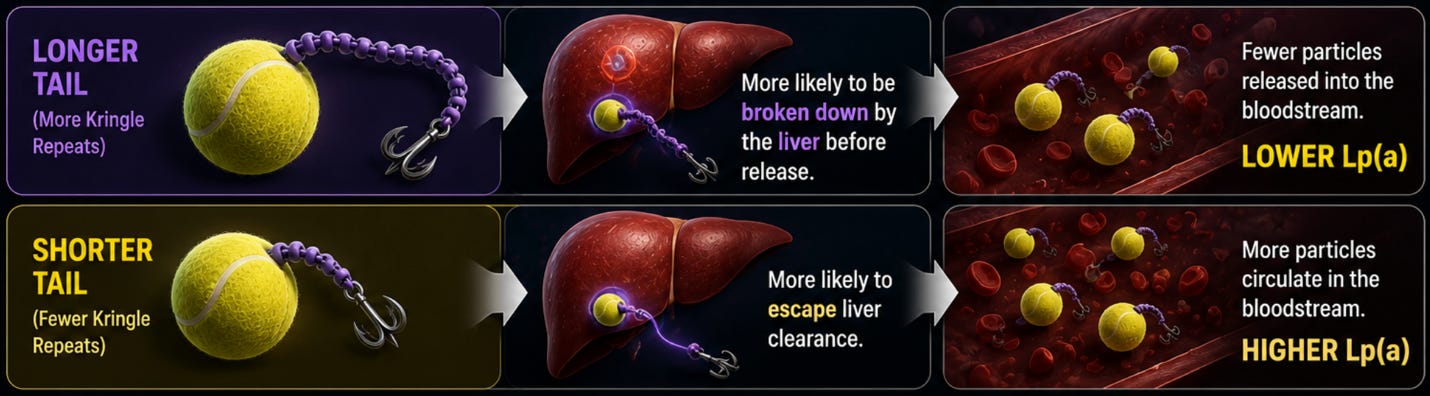
That’s exactly what happened in my family.
My father has an LPA gene with relatively few Kringle repeats, producing short-tailed Lp(a) particles. I inherited the same version. Because those particles are less likely to be cleared before entering the circulation, they accumulate in my bloodstream, giving me high Lp(a).
Should you measure it?
Well, I say, “yes,” as does virtually every major cardiovascular guideline.
Current risk categories are as follows:
<30 mg/dL (<62 nmol/L): Low risk
30–50 mg/dL (62–105 nmol/L): Mildly elevated risk
50–90 mg/dL (105–190 nmol/L): Substantially increased risk
>90 mg/dL (>190 nmol/L): Very high risk
My own levels float between the “substantially increased” and “very high” categories.

Yikes.
And yet, despite having elevated Lp(a) and historically extraordinarily high LDL cholesterol, I have no detectable plaque in my coronary arteries.
More context HERE.
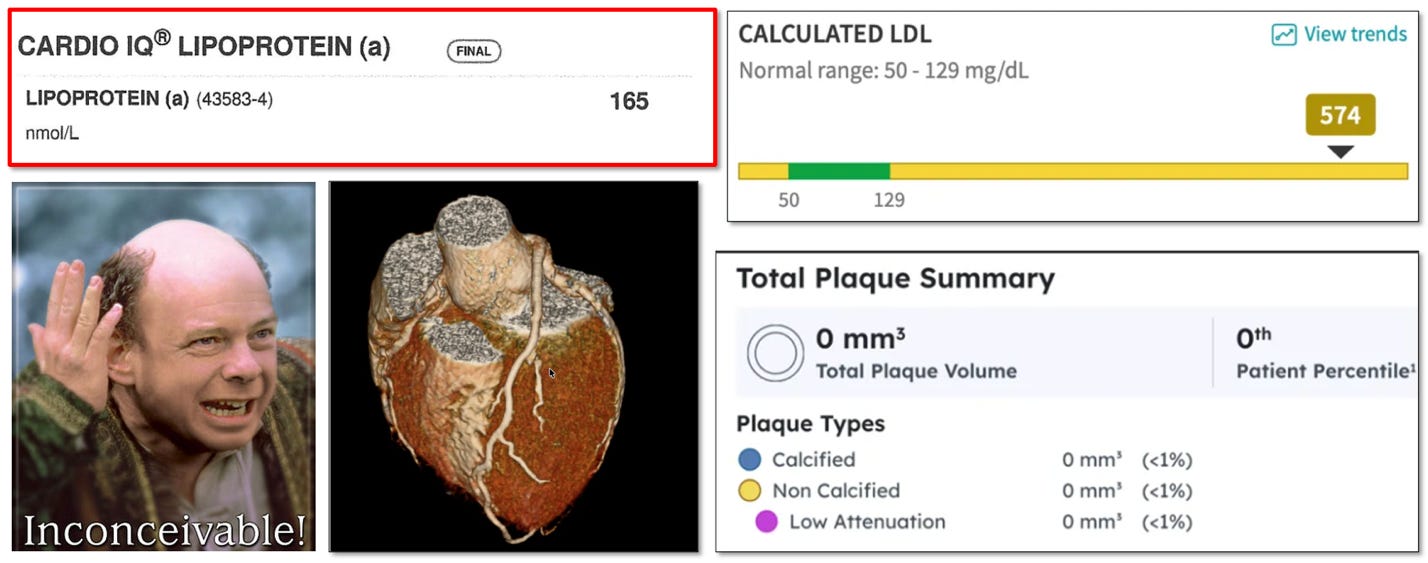
According to conventional cardiovascular dogma, that shouldn’t happen.
So, what’s protecting me? And could the same principles protect you?
*Hint: yes!
That’s what we’ll explore together, after we define how Lp(a) harms your arteries and accelerates cardiovascular disease.
Mechanisms: How Does Lp(a) Contribute to Cardiovascular Disease
The Vitamin C Story
To understand why Lp(a) increases cardiovascular risk, I want to walk you through two different ideas.
The first is the classic evolutionary hypothesis. The second is a newer mechanism that I think better explains the evidence we have today.
Let’s start with the older idea.
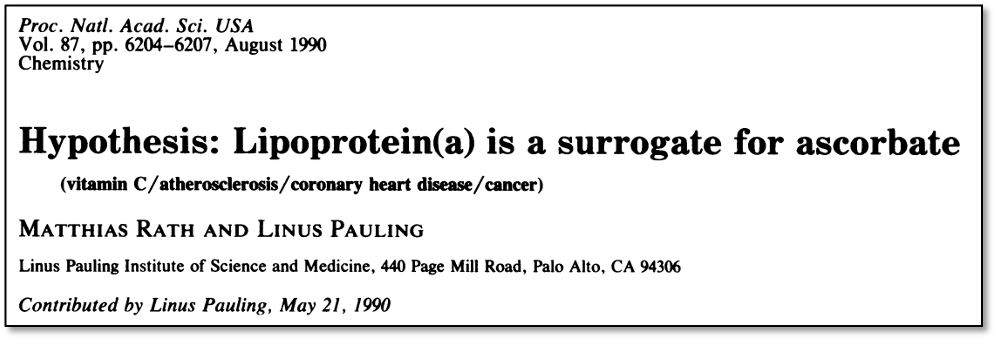
In 1990, two-time Nobel laureate Linus Pauling and his colleague, Dr. Matthias Rath, proposed a fascinating hypothesis. Their question was simple: Why would evolution develop a molecule that appears to increase the risk of heart disease?
Their answer had nothing to do with cholesterol.
It had to do with vitamin C, the scientific term for which is ascorbate (or ascorbic acid), literally translating to “anti-scurvy.”
Unlike most mammals, humans cannot manufacture vitamin C.
Giraffes? Sure.
Snakes? You bet!
Humans? Nope.
That’s because roughly 40 million years ago, our primate ancestors acquired a mutation in the GLO gene, which disabled the pathway for making vitamin C. Ever since then, we’ve depended entirely on our diet to obtain it.
Why does that matter?
Because vitamin C is essential for producing healthy collagen, the structural protein that gives blood vessels much of their strength. Without enough vitamin C, wounds heal poorly, blood vessels become fragile, and bleeding becomes much more likely.
Scurvy is the extreme example of vitamin C deficiency, manifesting as bleeding gums, easy bruising, small red spots on the skin (petechiae), and poor wound healing.
That makes sense now, doesn’t it?
And that’s right: giraffes can’t get scurvy.

Anyway, Pauling and Rath proposed that evolution found a workaround.
Their hypothesis was that Lp(a) evolved to compensate—at least partially—for our inability to make vitamin C.
Lp(a) could help patch sites of vascular injury by binding to damaged tissue and promoting clot formation.
The issue is that, over the long term, this can promote atherosclerosis.
But I suppose evolution didn’t care much if you died of a heart attack at 68 once you’d produced your offspring.
Interestingly, there are a few observations consistent with this idea.
One is evolutionary. Wherever the ability to synthesize vitamin C has been lost, Lp(a) often appears. Guinea pigs, for example, independently lost the ability to produce vitamin C, and they also produce Lp(a)—a striking example of convergent evolution.
Animal experiments are also intriguing.
When guinea pigs are deprived of vitamin C, they rapidly developed atherosclerosis with abundant Lp(a) deposited within arterial plaques. Restoring vitamin C dramatically reduced these Lp(a) deposits.
Taken together, these observations are consistent with the idea that Lp(a) functions as a kind of emergency repair system:
It homes in on injured blood vessels, binds to sites of damage via its apo(a) “grappling hook,” and helps stabilize the injury through clot formation.
The catch, of course, is that what may have been beneficial when traumatic injuries were common becomes problematic in a world where the “injury” is chronic inflammation inside an artery.
The same repair process that might once have saved your life could now contribute to plaque growth and, ultimately, heart attacks.
It’s an elegant hypothesis.
But that’s less than half the story.
Over the past decade, researchers have uncovered an even more interesting mechanism that adds nuance to our Lp(a) story and answers the question:
Why can two people have the same high Lp(a), but radically different cardiovascular risk associated with Lp(a)?
In the rest of this article for StayCurious Metabolism Premium members, we’ll unpack this newer mechanism before translating it into a practical, evidence-based protocol.
We’ll cover:
What Lp(a) really does inside the artery
Nutritional interventions and lifestyle strategies to reduce the risk associated with elevated Lp(a)
Common questions about Lp(a), answered in a straightforward way
The results of the new Lp(a) Horizon Phase III trial.
If you’re passionate about seeking optimal health through nuance and understanding, join the world’s fastest-growing premium Science Substack, and the community of curious people who make it so special.
I promise to do everything in my power to make your membership worth the investment because this community fuels my mission to make metabolic health mainstream.