

When it comes to protecting your long-term brain health, you need to think about fat—specifically visceral fat, the inflammatory fat that accumulates deep within the abdominal cavity, wraps around your organs, infiltrates the liver, surrounds the intestines, and contributes to metabolic dysfunction.
But the story of visceral fat just took a fascinating turn.
A new 2026 study from an international team of researchers spanning Harvard, Israel, and Germany suggests that the more exposure you have to visceral fat over the course of your life, the faster your brain shrinks.
What makes this study particularly compelling is the methodology.
The Study in a Nutshell
The researchers drew from four previous lifestyle randomized controlled trials in which participants underwent:
Visceral fat measurements
Brain MRI scans and
Cognitive testing
Collectively, this created a remarkably powerful dataset for examining the relationships among visceral fat, cognition, and actual brain structure.
Importantly, it also allowed the researchers to begin to tease apart a critical question: Does brain health improve because people lose weight in general, or because they specifically lose visceral fat?
I won’t starve you for the punchline...
Among participants who underwent brain MRI scans and visceral fat imaging, lower long-term visceral fat exposure was associated with slower brain atrophy.
Notably, this relationship was not observed for subcutaneous fat, the type that sits beneath the skin and jiggles when you poke it.
And the association remained significant even after accounting for numerous potential confounders, including age, sex (the noun, not the verb), changes in BMI, adherence to the prescribed diets, and other relevant variables.
That’s a powerful finding.
However, for those of us who spend our days immersed in metabolism research, it may feel intuitive… even unsurprising.
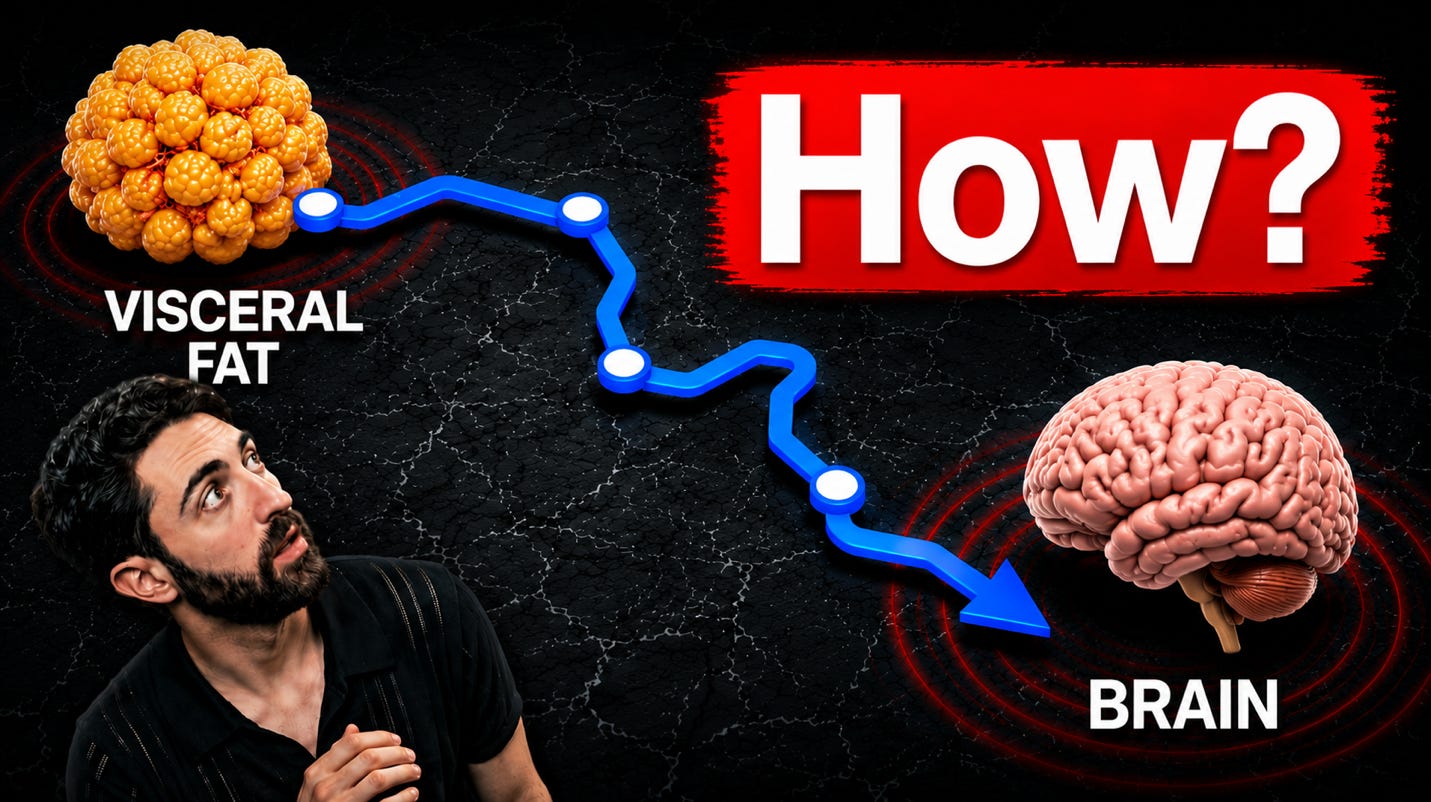
But what is more surprising and more interesting is: How?
If there is a causal relationship between visceral fat and brain shrinkage, what are the biological mechanisms?
And how can we use those insights to preserve cognitive function, maintain mental sharpness as we age, and potentially reduce our risk of neurodegenerative diseases such as Alzheimer’s?
That’s exactly what we’re going to explore in today’s deep dive.
And I promise you’ll walk away with a practical insights and tools you may not have thought about before.
In the rest of this letter for StayCurious Metabolism Premium members, we’re going to dive into the mechanisms by which visceral fat talks to (and abuses) the brain.
We’ll also cover evidence-based strategies for reducing visceral fat, including:
The #1 nutrient shown to reduce visceral fat without cutting calories
A peptide backed by randomized controlled trials that can slash visceral fat like a hot knife through butter.
If you’re someone who enjoys exploring the frontier of metabolic health and practical ways to optimize your biology, come discover why StayCurious Metabolism is the fastest-growing premium science newsletter on Substack.