


The biotechnology company Enveda just announced what could be a first-of-its-kind exercise pill.
I say “first-of-its-kind” not just because of its biological effects, but because of how it was discovered.
Enveda, a company with which I have no conflicts of interest, has the motto, “Life is smart, let’s learn from it.”
And they’re now using AI to help sort through the library of natural molecules found in our bodies and those of other organisms to try to develop metabolic medicines.
And they might have just had a major breakthrough, with positive results from a Phase 1 trial for a compound called ENV-308, which is being termed:
“The first pill designed from the chemistry of exercise.”
The story here is beautiful, but to really understand it, we need to start with a problem.

How We Discover Drugs Today
It’s easiest to describe the problem by telling you how we discover drugs right now.
We first identify a target, like a receptor or a desired biomarker change, and then try to figure out how to impact that target. For example, when it comes to heart health, one target medicine chose to focus on was cholesterol. So, we went looking for things that inhibit cholesterol synthesis. Eventually, we came to statins. You could say something similar about the discovery of blood pressure medications, and so on.
This new approach flips the script.
It looks at desirable physiological states, the buffet of natural compounds with which they’re associated, and then figures out what in that complex biological soup is actually relevant.
Take exercise.
When you exercise, thousands of molecules change in your blood. The problem is that it’s hard to know which of those are most important and which drive the effects of exercise. It’s like if you tasted an incredible dish and had to reverse-engineer the recipe, except there are literally thousands of ingredients, most of which you haven’t heard of and are packaged in containers with no labels. Tricky, right?
AI is what helps solve that problem.
Searching Nature’s Library
The technology Enveda uses, called PRISM, is a way to use artificial intelligence to search the enormous chemical library that already exists in nature.
You collect samples, say at rest and during exercise, and then use a technique called mass spectrometry, which breaks molecules into little pieces and measures those pieces, creating something like a chemical fingerprint. You can then use machine-learning models to help organize natural molecules into a searchable library.
The next step is where things get very interesting, because we don’t need to say, “We want to target X, so let’s find something that blocks X.” Instead, you can look for molecules that produce a desired biological response more broadly, like the molecular pattern associated with exercise.
This is what’s known as “phenotypic drug discovery,” i.e. drug discovery to mimic a phenotype, or physiological state.
So then, en masse, you can expose cells to different natural molecules that come up in your library and see how they respond. This gives you a much richer picture of what a compound is doing, rather than simply asking whether it binds to a particular protein and inhibits a single pathway.
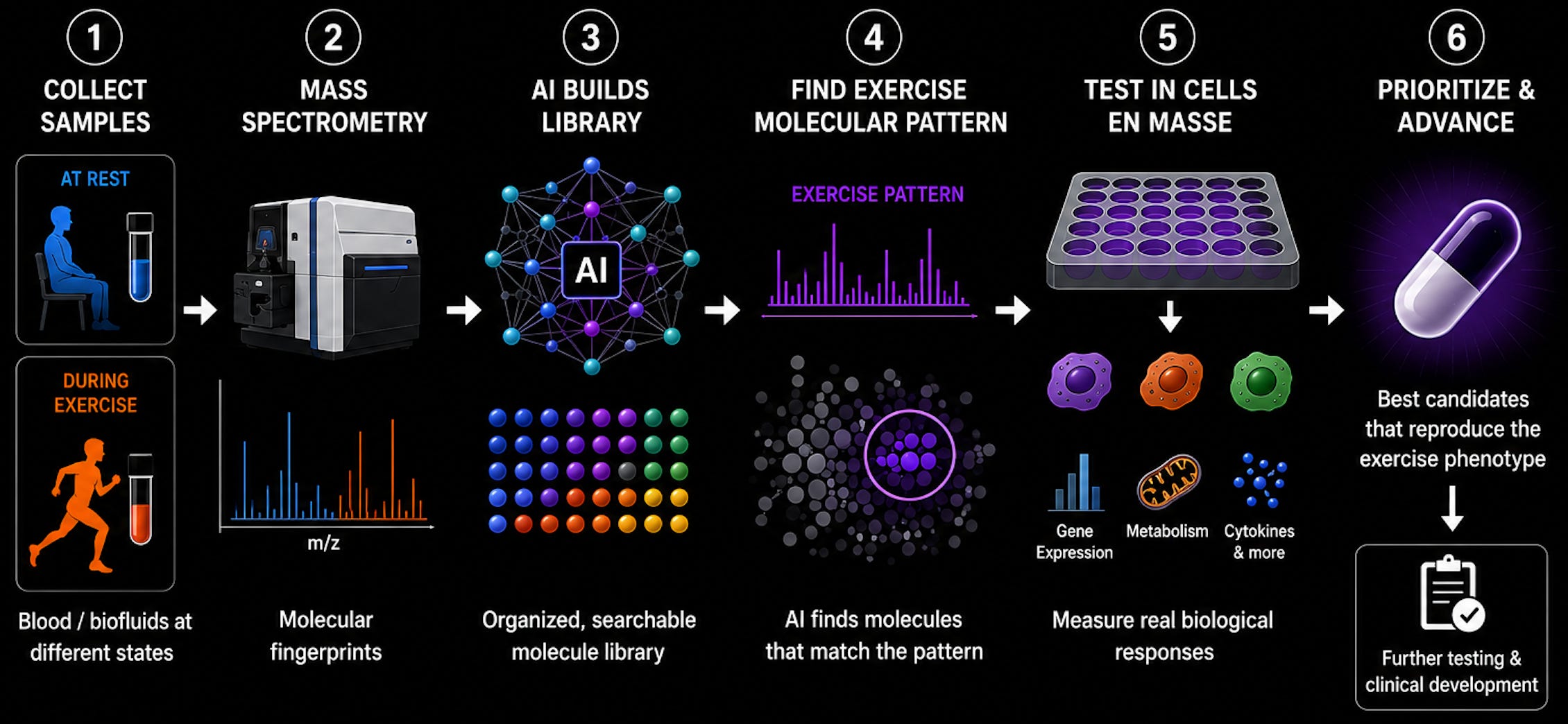
The reason this is so attractive as an idea is that it makes it more feasible that we could maybe mimic some of the benefits of a complex biological process like exercise. Exercise doesn’t work through a single molecular pathway. It activates an enormous number of genes and proteins. It affects mitochondria, skeletal muscle, glucose metabolism, inflammation, hormones, and so on.
So, the old drug-discovery approach wouldn’t really work if the question were, “Which molecule binds to an exercise receptor?” There’s no single exercise receptor. We need something more comprehensive. And perhaps now we have it.
That was the basis that led Enveda toward the discovery of ENV-308. So, let’s talk about ENV-308 and its natural biological parent: a molecule called Lac-Phe.
Meet Lac-Phe
The story begins, as the technology does, with nature. The landmark paper that starts our journey was published in the journal Nature by researchers out of Stanford in 2022.
They discovered a molecule produced during exercise across species known as N-lactoyl-phenylalanine, or Lac-Phe. They found that exercise, particularly high-intensity exercise like sprinting, increases Lac-Phe massively in mice, racehorses, and humans.
But when they first ran the experiment, they had no idea what Lac-Phe was. It just came up as a signal of some unknown molecule that spikes during exercise.
But they then used that mass spectrometry technology I mentioned to identify Lac-Phe, the name of which comes from its two component parts: it is a combination of lactate, produced during exercise, and phenylalanine, an amino acid. But combined, they make something new, something neither of the component parts can do alone.
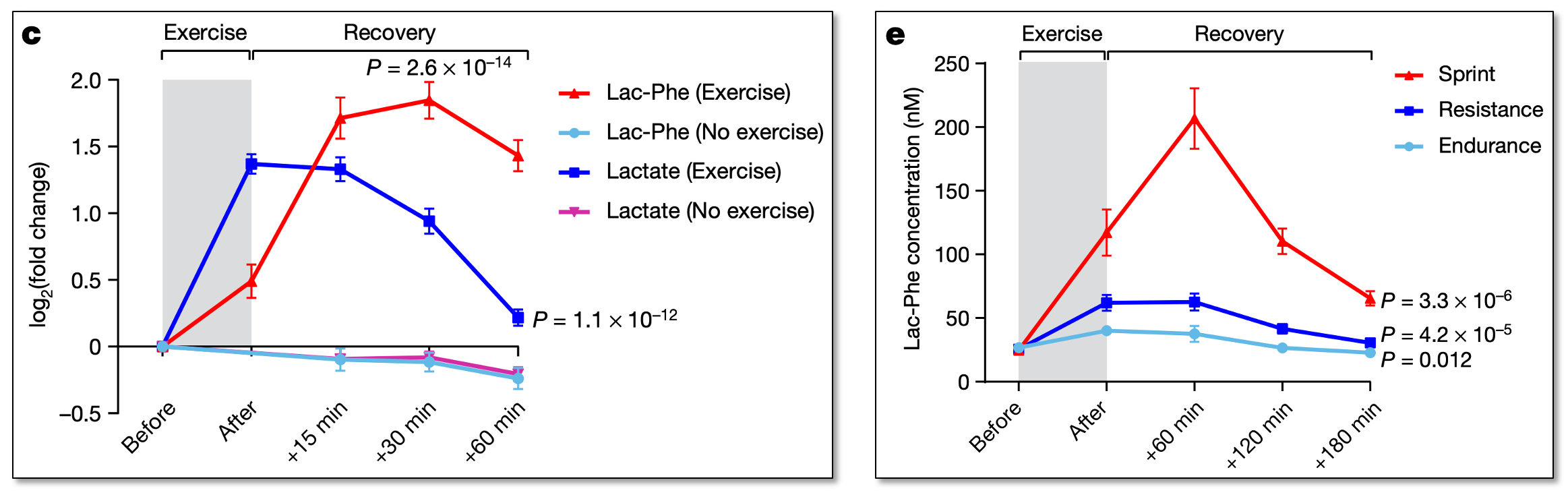
What you’re seeing below is what happens to Lac-Phe after exercise in humans.
Left: You can see it starts to rise and then continues to rise and stay elevated for more than an hour after exercise, likely because the body continues to make it to some extent.
Right: Intensity is also important, which is unfortunate for those who don’t like high-intensity workouts. What you’re seeing here is Lac-Phe levels after endurance training, say jogging, resistance training, and sprinting. Very clearly, the sprint produces the greatest Lac-Phe surge.
What Is Lac-Phe Actually Doing?
All right, but what is Lac-Phe doing?
Well, inhibiting food intake.
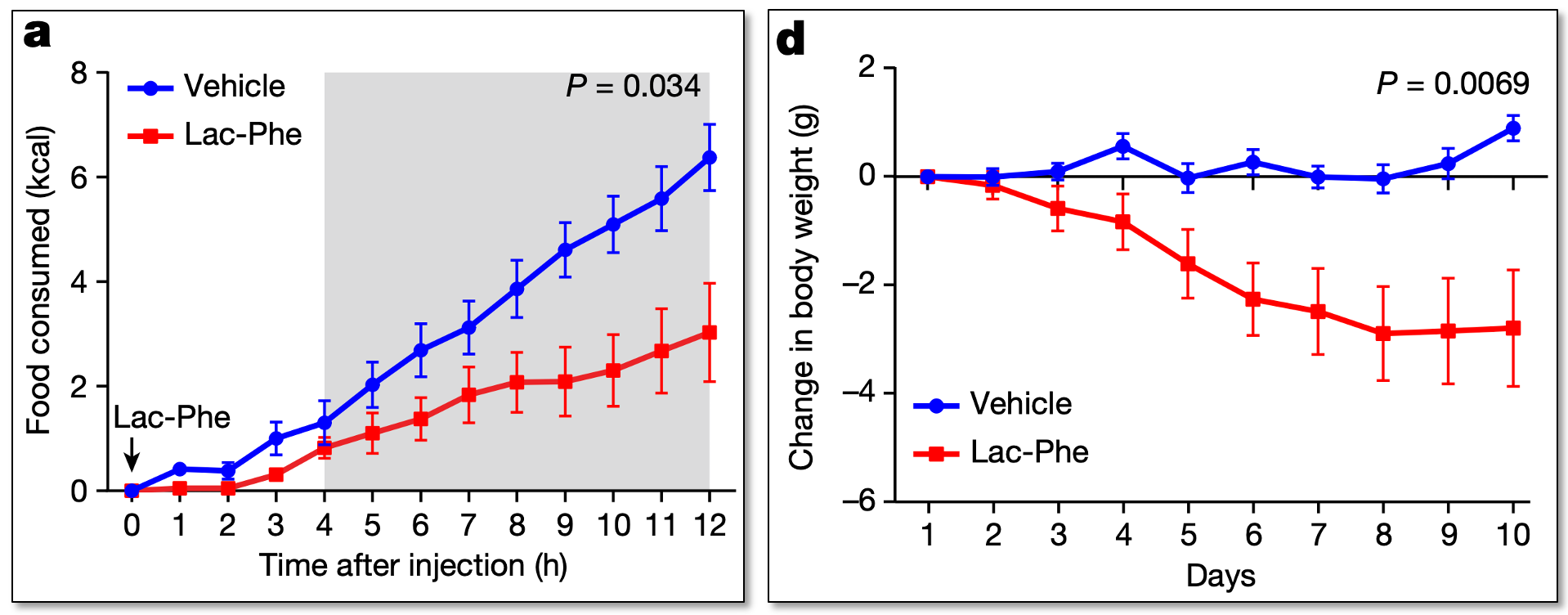
When researchers gave Lac-Phe to obese mice, it suppressed food intake (left, red line) by approximately 50% compared with control mice (blue line). It did not change activity, and it did lead to progressive weight loss (right) and improvements in blood sugar control.
But I’m sure you’re now wondering, “Does it work in humans?”
Well, this is where things get both tricky and interesting. You can’t easily give Lac-Phe itself as a drug, because the body breaks it down too quickly to sustain a useful level. That’s why we need a molecule that can be taken by mouth and that lasts long enough to do the job, while mimicking what Lac-Phe does. That’s ENV-308.
However, there is an incredibly common medication that does appear to increase Lac-Phe and reduce appetite in humans.
In the rest of this letter for StayCurious Metabolism premium members, we’ll discuss:
The $4 medication that increases Lac-Phe in humans
The pros and cons of this medication
Why this new method of drug discovery is so exciting
The resource I use when I want to tinker at the frontier of my own biology
If you’re somebody who likes to live and learn at the frontier of metabolic health, I hope you’ll consider joining the StayCurious Metabolism community and becoming a part of what makes it so special.

