


As a neuroscientist at high risk for Alzheimer’s disease, I’m constantly looking for new ways to protect my brain for the long haul.
And a new paper that just dropped in Neuron had me smiling ear to ear because it reveals a previously unknown mechanism by which a well-known hallmark of Alzheimer’s disease drives the disease itself.
Better yet, it points to solutions that I already have in my medicine cabinet.
I’m going to break it down for you, starting with the science and then moving into practical tools you can start using today to help keep your brain sharp and healthy for decades to come.
But first, some background.
I want to introduce two key players: tau and mitochondria.
Tau Tangles: A Hallmark of Alzheimer’s Disease
You’ve probably heard of tau, particularly in the context of the neurofibrillary tangles seen in Alzheimer’s disease.
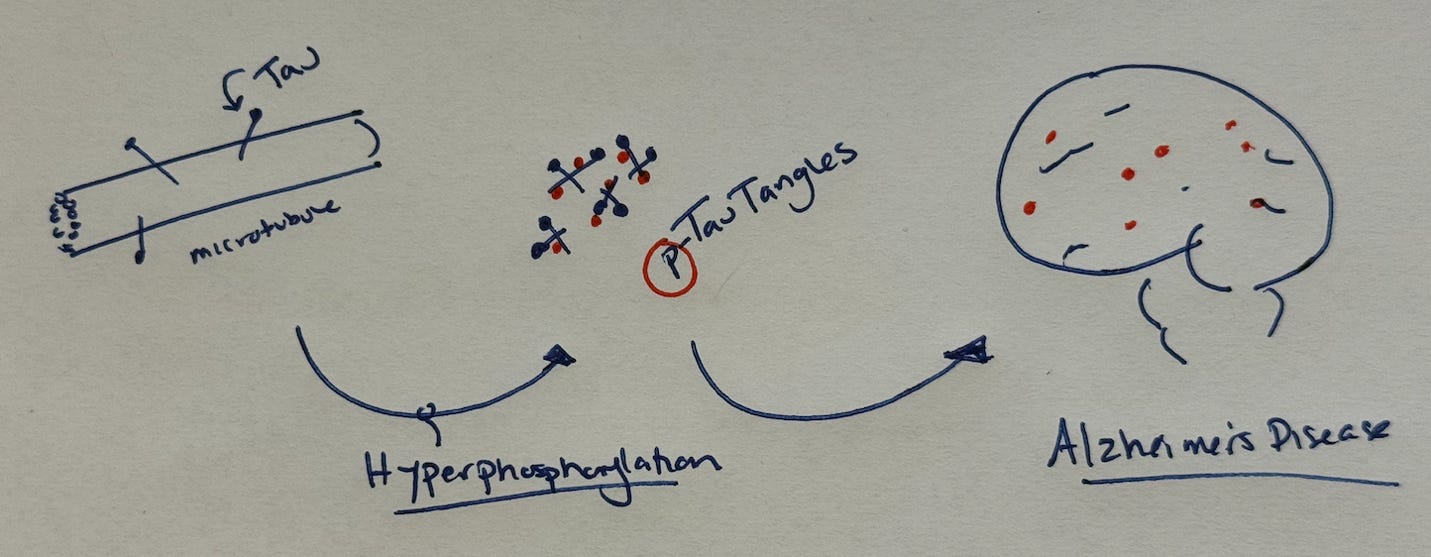
In Alzheimer’s and certain other “tauopathies,” this protein, which normally sits on the cell’s cytoskeleton, becomes tagged with phosphate groups, a process known as “hyperphosphorylation.”
This causes tau to detach, clump together into aggregates called phospho-Tau neurofibrillary tangles, and contribute to neuronal dysfunction and death. This tau pathology is one of the major driving forces behind Alzheimer’s disease.
Mitochondrial Dysfunction: Another Hallmark of Alzheimer’s Disease
Now let’s talk about mitochondria, and then I’ll bridge the two.
Mitochondria are, of course, “the powerhouse of the cell.” You’ve heard that before. But they are especially important in the brain, which is extraordinarily energy-hungry, consuming roughly 20% of your daily energy expenditure despite weighing only about two to three pounds.
Not surprisingly, mitochondrial dysfunction is also a hallmark of Alzheimer’s disease.
So how do these two players connect?
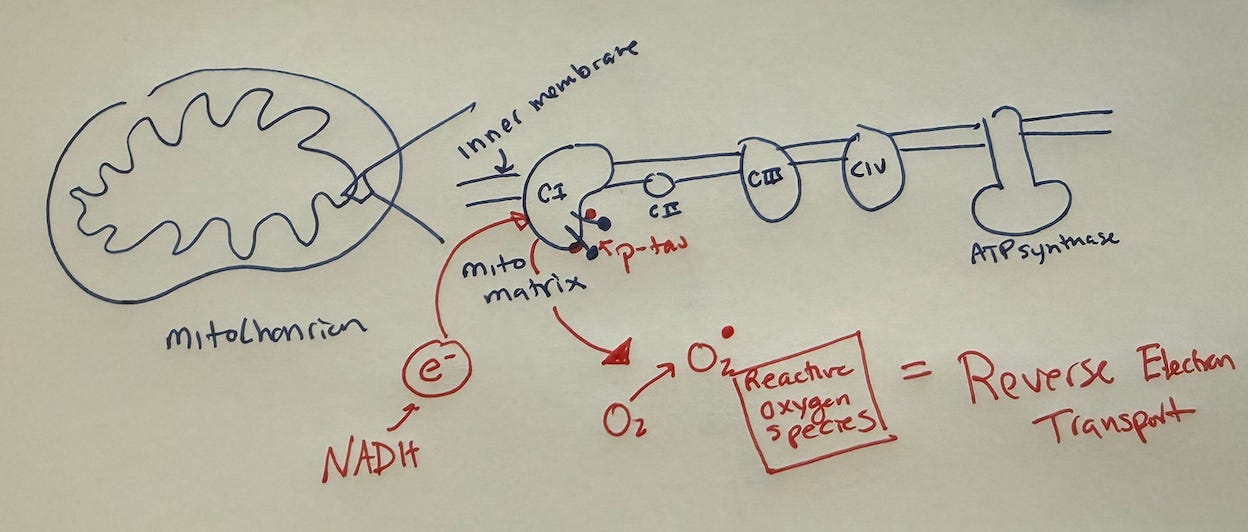
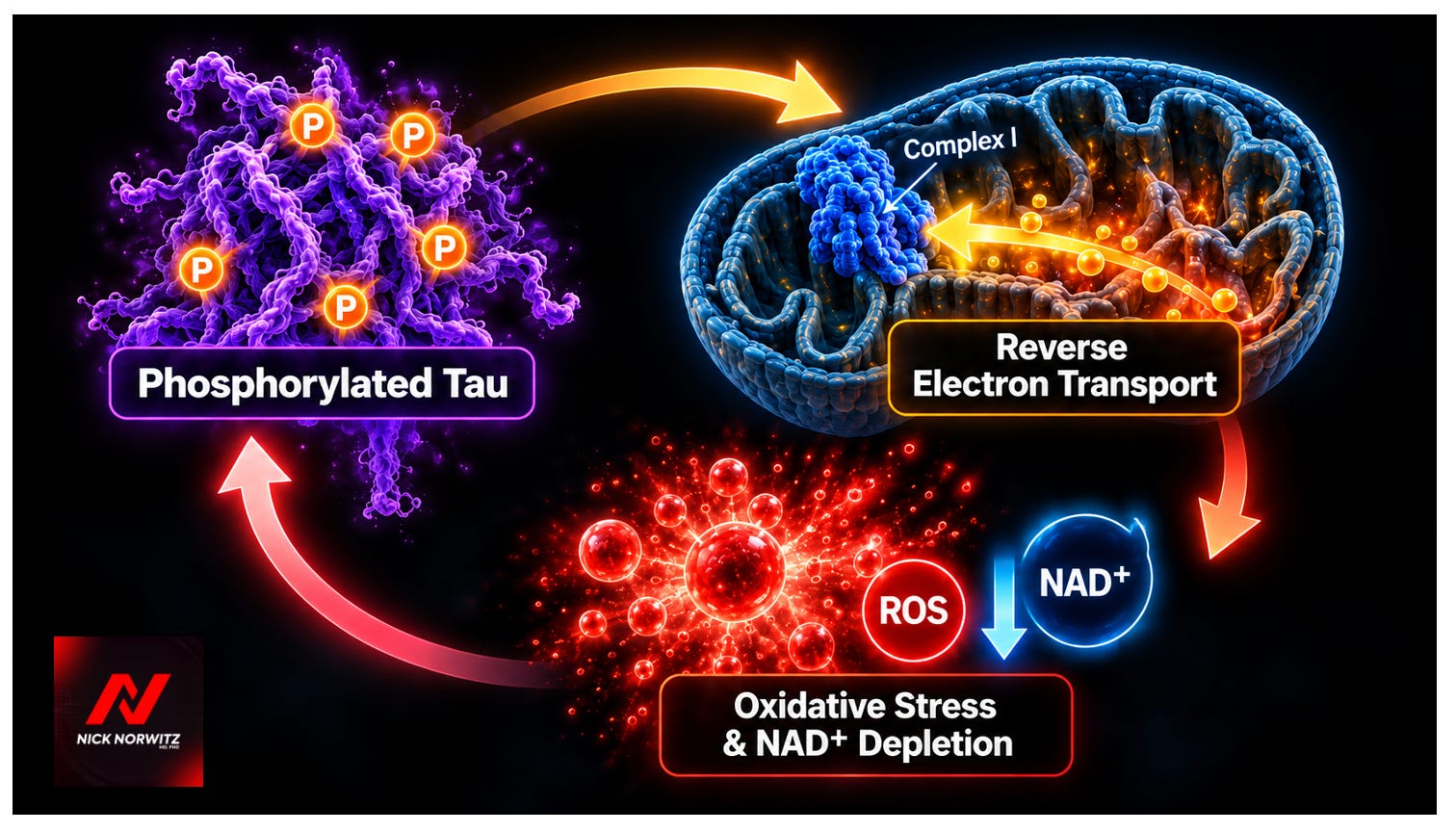
The revelation from this new paper is that hyperphosphorylated tau does something else: it binds inside mitochondria near the beginning of the electron transport chain and triggers a toxic process that simultaneously depletes energy production and damages neurons.
That process is called “reverse electron transport.”
Reverse Electron Transport
In a nutshell, here’s how it works.
Normally, mitochondria generate energy by collecting high-energy electrons and harvesting their energy to build a proton gradient, which ultimately drives ATP production. ATP is the cell’s energy currency.
But when tau attaches to Complex I (CI) of the mitochondrial electron transport chain, the system starts to clog.
Instead of flowing efficiently forward through the chain, some electrons flow backward or leak out altogether.
Those escaped electrons react with nearby molecules and generate harmful reactive oxygen species, creating oxidative stress.
The result is a double hit: Energy production falls, while the very electrons that should have been used to generate ATP instead contribute to neurotoxic damage.
In what follows, I’m going to walk you through the data that revealed this new mechanism.
That will lay the groundwork for your understanding of the interventions we will discuss thereafter.
The Evidence: Cross-Species and Cross-Disease
First, the researchers confirmed that reverse electron transport is ramped up in every tauopathy model they tested.
In human neurons, flies, mouse models, and in human brain tissues from patients with Alzheimer’s disease, levels of ROS were significantly elevated and the NAD⁺/NADH ratio was significantly reduced, both of which are hallmarks of active reverse electron transport (NADH drops off electrons at Complex I creating NAD+, and reverse transport ends up increasing NADH relative to NAD+).
But it gets worse before it gets better. Because there was also a vicious cycle.
The researchers discovered that reverse electron transport and tau hyperphosphorylation feed into each other in a self-perpetuating loop.
Hyperphosphorylated tau enters the mitochondria, binds to a subunit of Complex I and activates reverse electron transport.
That reverse electron transport then produces excess ROS and tanks the NAD⁺/NADH ratio, which activate the very enzymes, including one called GSK-3β, that phosphorylate tau in the first place.
Basically:
More phosphorylated tau → more reverse electron transport → more oxidative stress and NAD⁺ depletion → even more phosphorylated tau → and so on.
It’s a vicious cycle. Or, more poetically: a biological doom loop.
But understanding shouldn’t be the road to fear, but to solutions.
The Drug That Rescued Brains (In Mice)
The next challenge is to break the biological doom loop.
The researchers did so using a compound known as CPT. CPT is a small-molecule inhibitor of reverse electron transport. It works by targeting the same Complex I subunit that tau latches onto.
Think of it as a chemical bouncer that shoves tau away from the mitochondrial machinery and shuts down the backward electron flow.
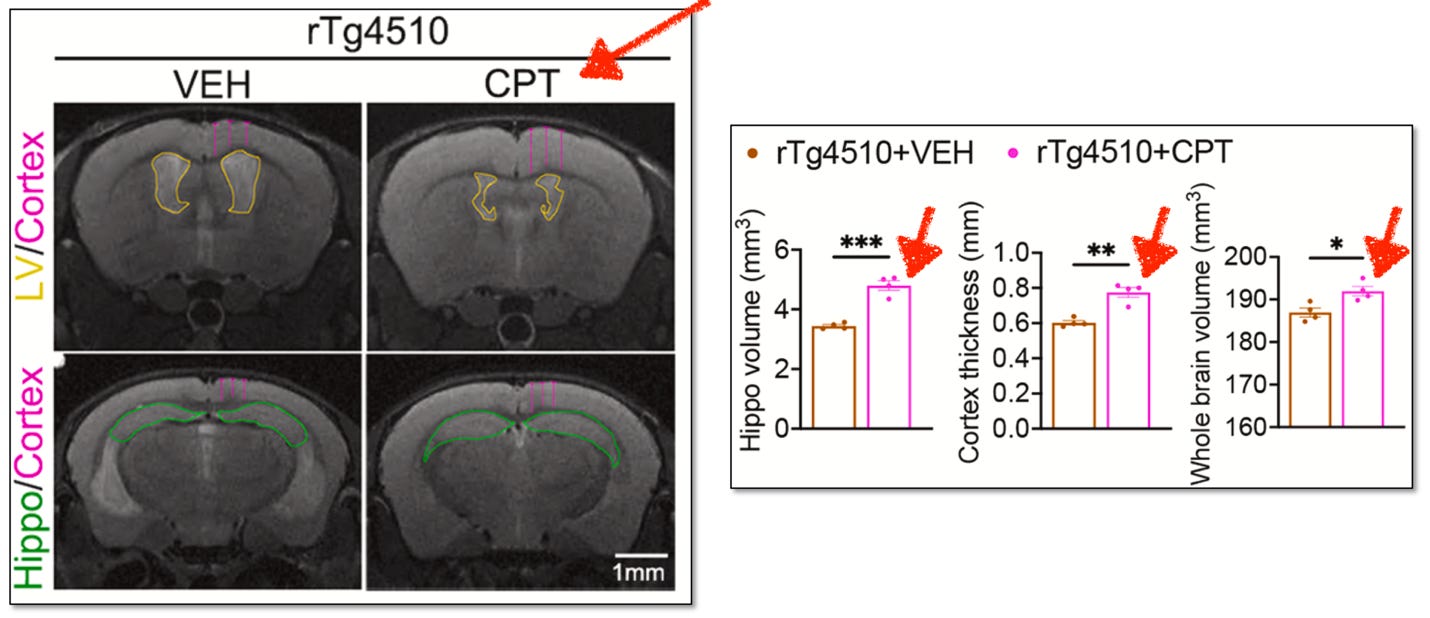
When the researchers tested CPT in a mouse model the results were impressive.
Improved Cognition: In standard tests for spatial memory (the Morris water maze) and associative learning (fear conditioning), the CPT-treated mice showed improved memory.
Reduced Brain Atrophy: On MRI (below), CPT-treated mice showed increased cortical thickness and larger hippocampal volumes as compared with untreated tauopathy mice. In plain language: the drug protected against the physical shrinkage of the brain.
Reduced Neurodegeneration: Blocking reverse electron transport also rescued the number of healthy neurons.
Improved Neuroinflammation: And CPT dramatically reduced inflammatory activation of multiple cell types (astrocytes, microglia and CD8⁺ T cells) that contribute to neuroinflammation and brain damage.
The point here is that by blocking reverse electron transport, a mechanism at the core of the vicious cycle driven by tau pathology in the Alzheimer’s brain, it appears we can break the loop and improve multiple hallmarks of Alzheimer’s.
Three Interventions in My Medicine Cabinet
However, CPT is not available to the public. It’s a preclinical compound. We may be years away from human trials.
So, with all of this in mind, let’s get practical.
What can you actually do today?
In the rest of this letter for StayCurious Metabolism Premium members, we’ll dive into:
Three tools that target these mechanisms
How they work
How to get them
And what it means for your long-term brain health
If you’re the kind of person who wants to stay at the cutting edge of metabolic health, neuroscience, performance, and longevity, you’ll feel right at home in the StayCurious Metabolism community. It’s built for people who believe curiosity is the antidote to a world saturated with overly simplified platitudes.

